We hadn’t planned on visiting the Taean Horticultural Therapy Expo. We’d just left Kkotji Beach after our two-hour family stop, and on the way back to the highway my wife noticed huge banners along the road advertising “2026 Taean International Horticultural Therapy Expo.” The banners had pictures of giant flowers, character cutouts, and what looked like Tini-Ping mascots. Our 9-year-old daughter spotted the Tini-Ping banners and stopped negotiating about going home. We pulled in.
The entry fee was steeper than I’d expected, 15,000 KRW per adult, 9,000 KRW per kid, totaling 48,000 KRW for our family of four. I almost turned back at the ticket booth. We didn’t. By the end of the two hours we had inside, the consensus was: worth the price, but we’d needed twice as long. This is our honest pros-and-cons review of visiting with kids, what worked, what didn’t, and what we’d do differently if we go back.
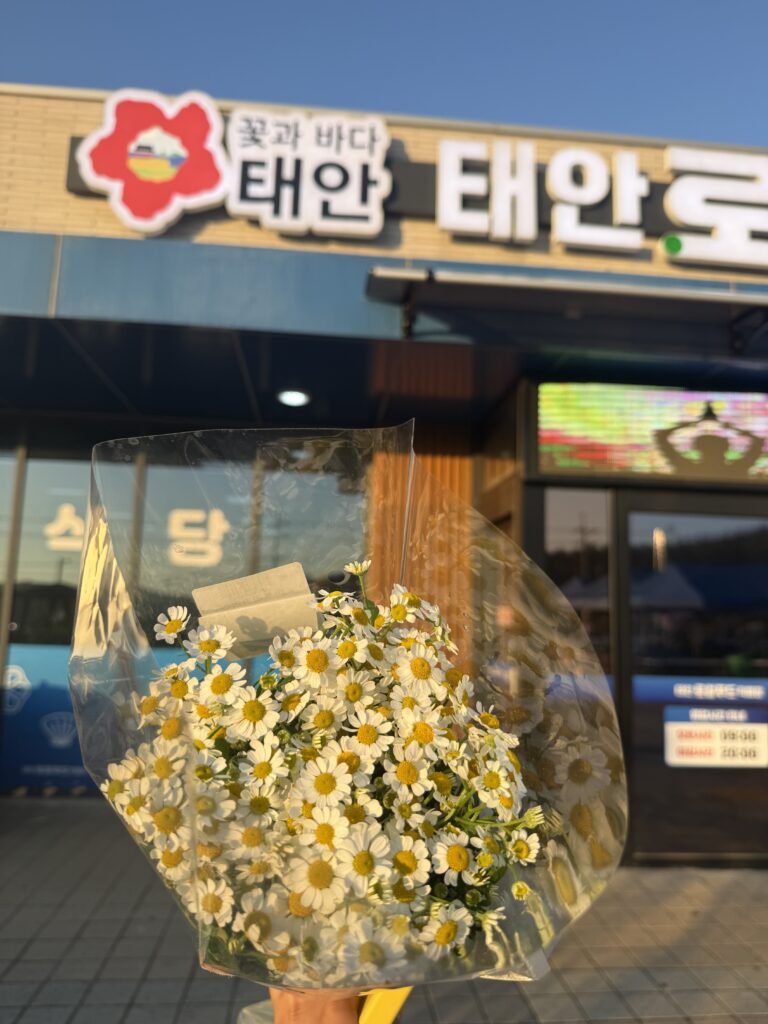
The 4 p.m. Decision That Cost Us Three Hours
Hosted on a sprawling outdoor and indoor venue in Taean-gun, Chungcheongnam-do, the expo runs through May 24 in 2026. It combines traditional flower exhibitions with tech-forward installations alongside it. Horticultural therapy displays, interactive digital flower experiences, character mascot zones, and special pavilions that lean closer to immersive art than to a typical gardening fair. For families with young kids, variety is the headline.
The price is the main hesitation. 48,000 KRW for a family of four is not insignificant, especially for what’s essentially a half-day visit. Once inside, the entry fee covers everything. Free hands-on activities. Free ginseng pot planting. Access to all special pavilions. No hidden upcharges. No paid skip-the-line passes. The money you pay at the door covers everything except food.
The honest verdict: if you can arrive by noon and stay until close at 6 p.m., the expo is worth the cost. If you arrive at 4 p.m. like we did, you’ll see maybe half of it and leave wanting more. The 9 a.m. to 6 p.m. operating hours sound generous on paper, but the indoor pavilions take real time to walk through, and the special pavilions have lines that build up in the afternoon. Plan accordingly.
What the Sacred Garden Pavilion Felt Like Inside
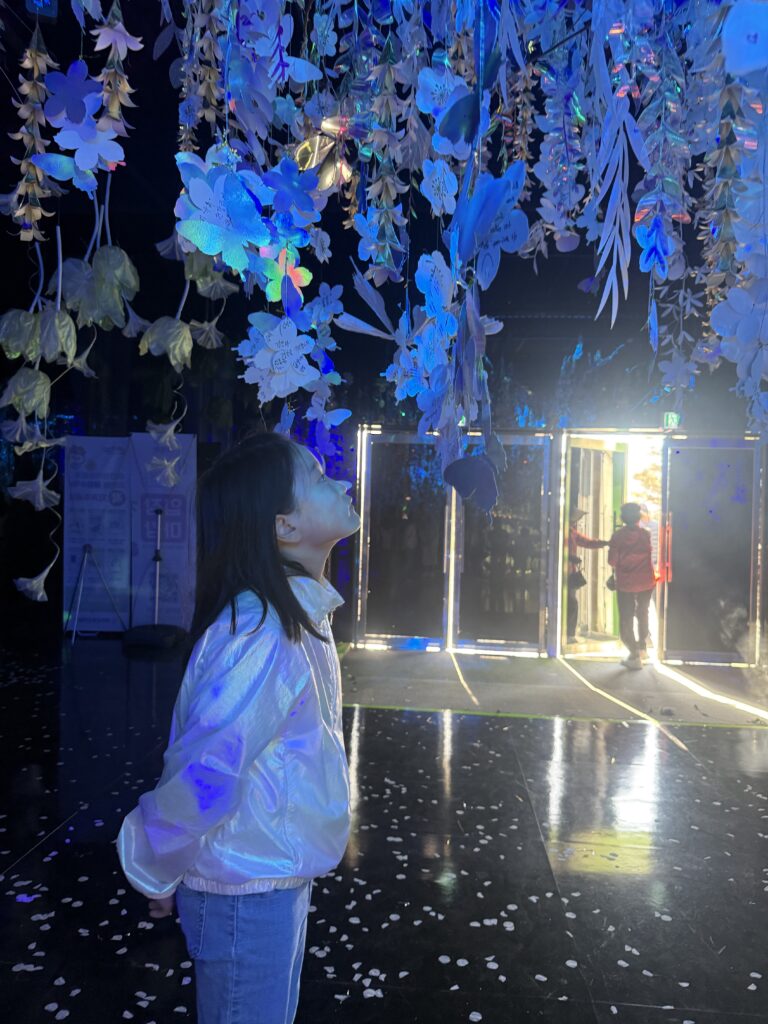
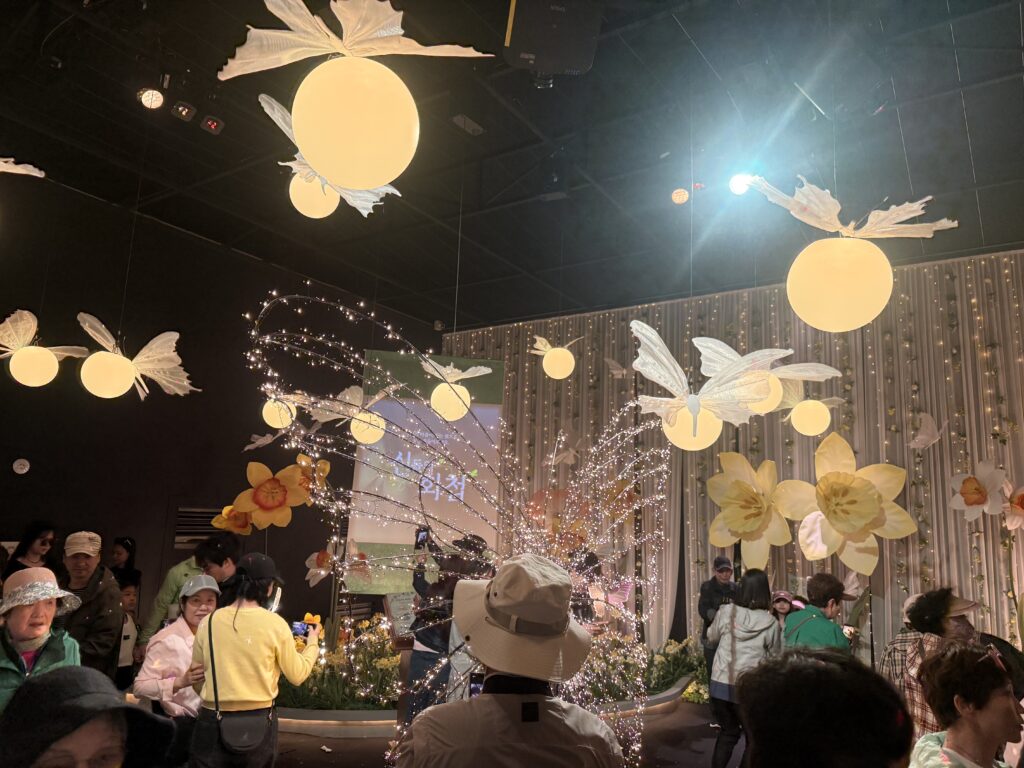
Our single best moment at the expo was the Sacred Garden (신들의 치유정원) special pavilion. The concept was that visitors enter as butterflies invited into a mystical garden. The pavilion was a fully enclosed dark room. Electric-blue LED-lit paper flowers hung from every direction. Projection mapping covered the floor and walls. Motion-triggered audio responded to your movement. Walking through it felt closer to walking through a Yayoi Kusama installation than a flower fair.
Both kids stopped talking the second we entered. Our 10-year-old had been complaining about being hungry just two minutes earlier. He walked through the pavilion in silence. Our 9-year-old kept reaching out to touch the paper flowers. They’d light up brighter when touched, either a real interaction or her imagination. Either way she was thrilled. We spent a long stretch in the Sacred Garden alone.
An installation like this justifies the entry fee on its own. Production quality was higher than I expected from a regional Korean horticultural fair. Lighting designers, projection artists, and sound staff had clearly worked together. The space felt cohesive. For visiting families looking for something visually impressive that doesn’t require Korean reading skills, the Sacred Garden translates across cultures effortlessly.
The Tini-Ping Zones That Hooked the 9-Year-Old
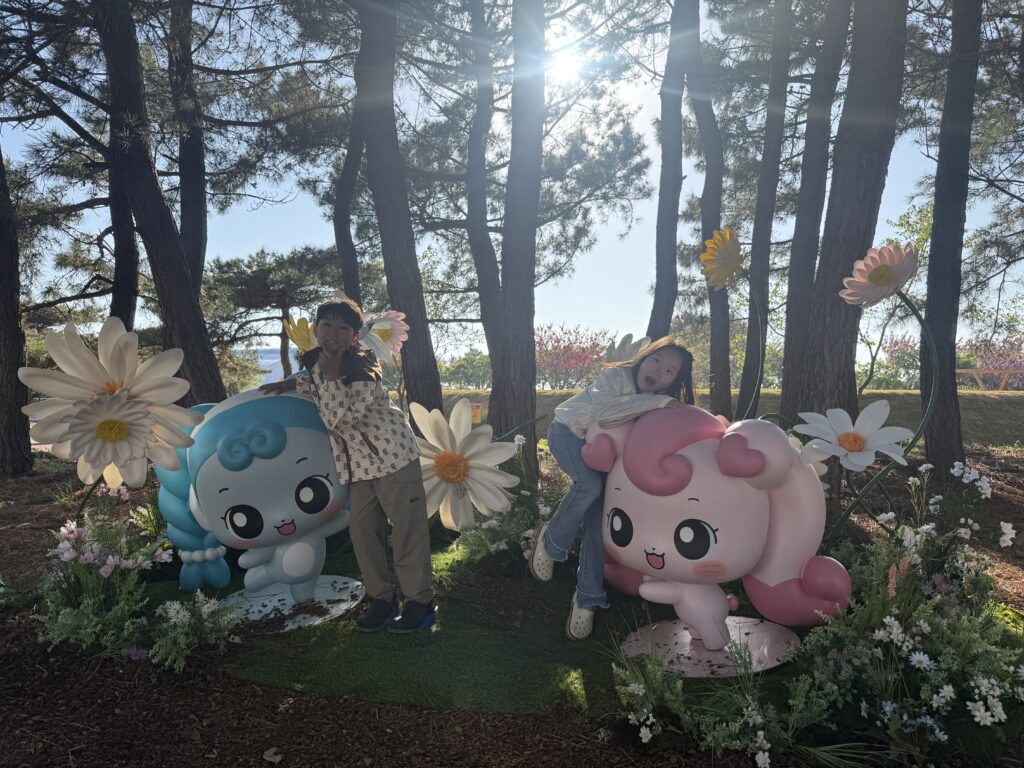
If you’ve spent any time around Korean elementary-school-aged kids in 2025 or 2026, you know about Tini-Ping (티니핑) already. It’s the dominant character franchise for kids 5 to 11 right now. Small pastel creatures, each with a distinct personality, sold as toys, plush, books, stickers, you name it. Our 9-year-old has approximately a thousand Tini-Ping items at home. She quotes Tini-Ping episodes verbatim. Her school backpack is a Tini-Ping backpack.
The expo had multiple Tini-Ping zones. Life-sized character cutouts in flower-themed photo zones. Giant fake daisies and decorated paths between trees. Our daughter recognized each character from across the path. She ran ahead to pose with each one. The 10-year-old was less interested but went along because his sister wouldn’t let him stand still. We took a lot of Tini-Ping photos in the time we spent in those zones.
For Korean kids the Tini-Ping integration is the strongest hook. For non-Korean visiting kids, the cutouts are just cute character sculptures with flowers, but they’re still photogenic enough to enjoy. The expo wasn’t subtle about the Tini-Ping marketing collaboration, but in 2026 it would be weird to host a kids’ horticultural fair without some character tie-in. They went with the strongest one.
Beyond Tini-Ping: The Other Mascot Zones
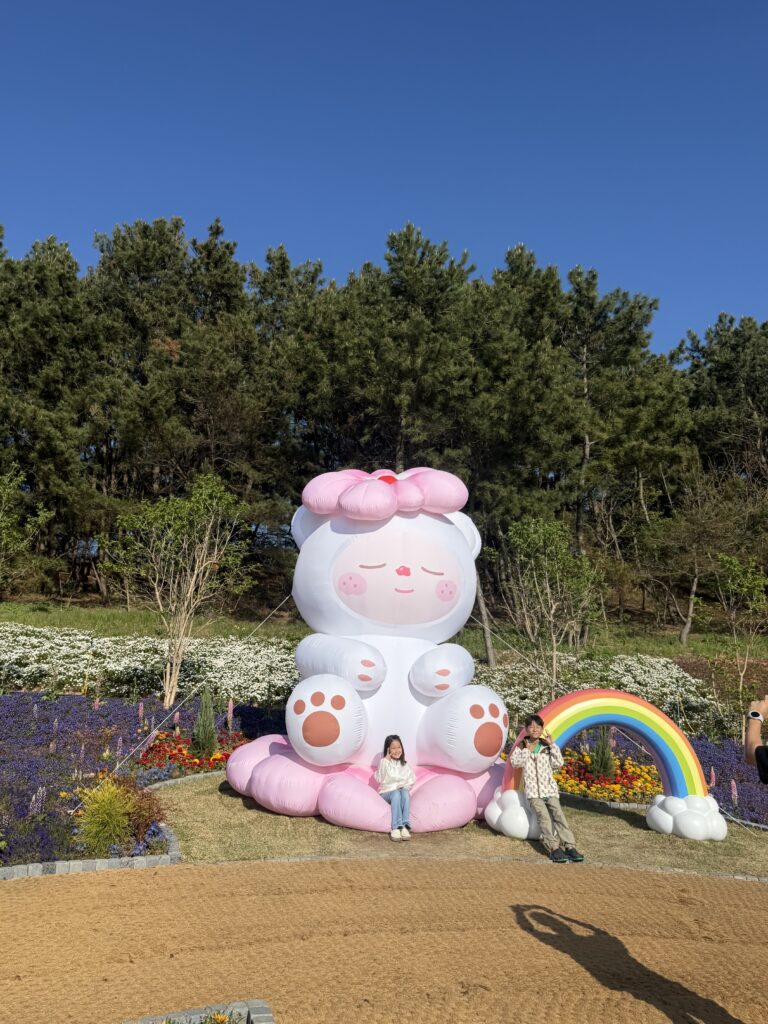
Beyond Tini-Ping itself, the expo had other large character installations. A giant pink rabbit with a rainbow next to a flower bed, oversized daisy and peony sculptures, and an inflatable mascot zone. Variety meant kids who didn’t care about Tini-Ping still had photo-worthy character moments at every corner. Our 10-year-old eventually warmed up to the rabbit because, in his words, it was “extremely large for no reason.”
AI Butterflies, AI Flowers, and a 10-Year-Old Trying Phrases
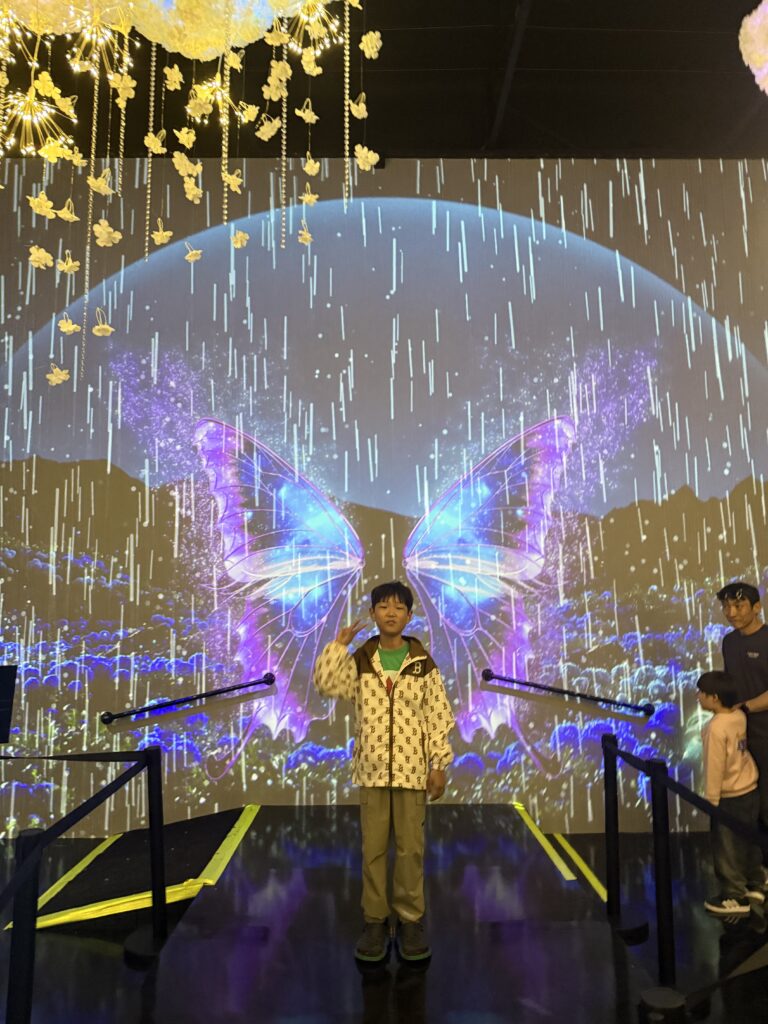
The expo’s biggest tech showcase was an AI-powered horticultural therapy installation. Inside one indoor pavilion, a curved screen filled most of the room. Projected on the screen was a giant digital butterfly. Visitors stepped onto a marked spot in front of the screen. The butterfly’s wings reacted in real time to your position. Moving when you moved, opening when you stepped closer.
In a separate small zone, kids could speak specific phrases (in Korean) to digital flowers projected on a wall. The flowers would respond by moving and “speaking back” via pre-recorded animations. Our 10-year-old spent a long stretch alone trying different phrases. “꽃아 안녕!” (“hello, flower!”) got the most reactions. He was, briefly, more curious about how the flowers worked than about the flowers themselves. That’s a win for educational design.
The integration of these tech demos into traditional plant-themed exhibits felt forward-looking. A bet that kids respond more to interactive tech than to static greenhouse displays. The bet worked, at least with our two.
Ginseng Pots and Other Free Activities
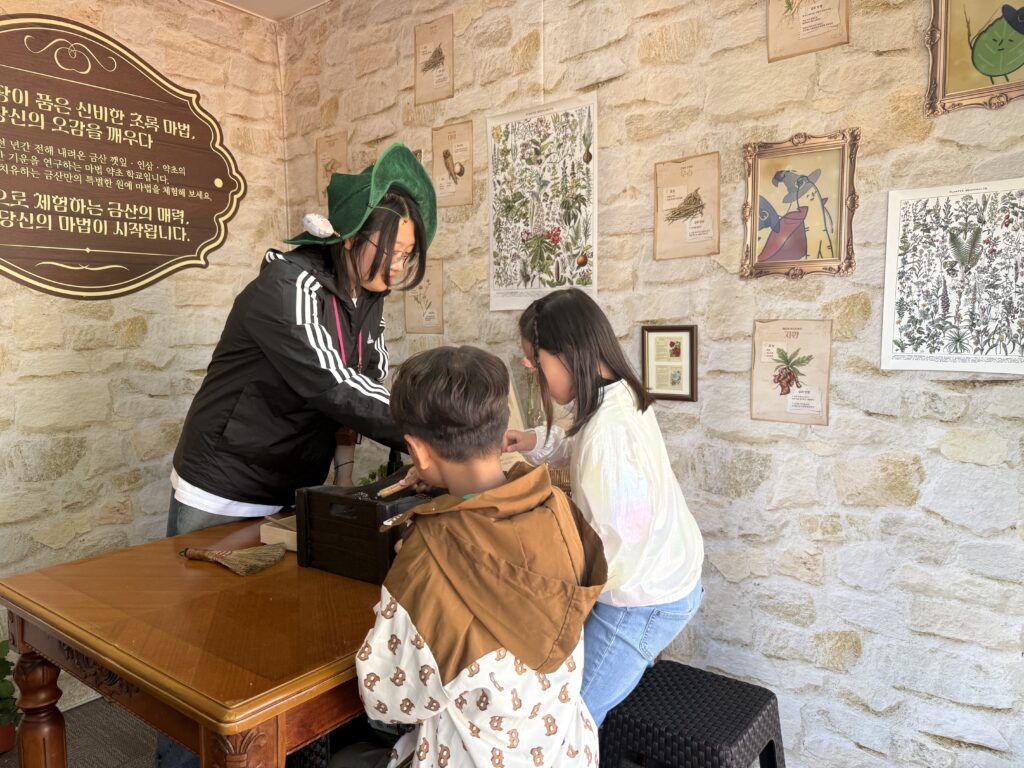
One of the unexpected wins was a free ginseng-planting activity. The expo had small wooden booths set up. Kids (and adults) could plant a ginseng sprout into a small ceramic pot. Decorate it with stickers. Take it home. The activity was free, included with the entry fee, and the staff helped each kid through the steps.
Both kids planted their own ginseng pots. The 9-year-old picked a yellow pot and decorated it with butterfly stickers. The 10-year-old went with a plain green pot and added two stickers reluctantly. Both pots survived the drive home and are now sitting on our kitchen window. The ginseng sprouts are still alive at the time of writing, three weeks in. Korean ginseng is hardier than I expected.
Beyond ginseng pots, the expo offered other free activities. Kids’ job-experience stations (where kids could try roles like florist or garden designer for short blocks each), seed-packet giveaways, and small craft tables with plant-themed coloring pages. Each activity was self-contained, walk-up, and didn’t require advance booking. The free activities alone justified the visit for the kids.
The Outdoor Flower Walks We Saved for Last
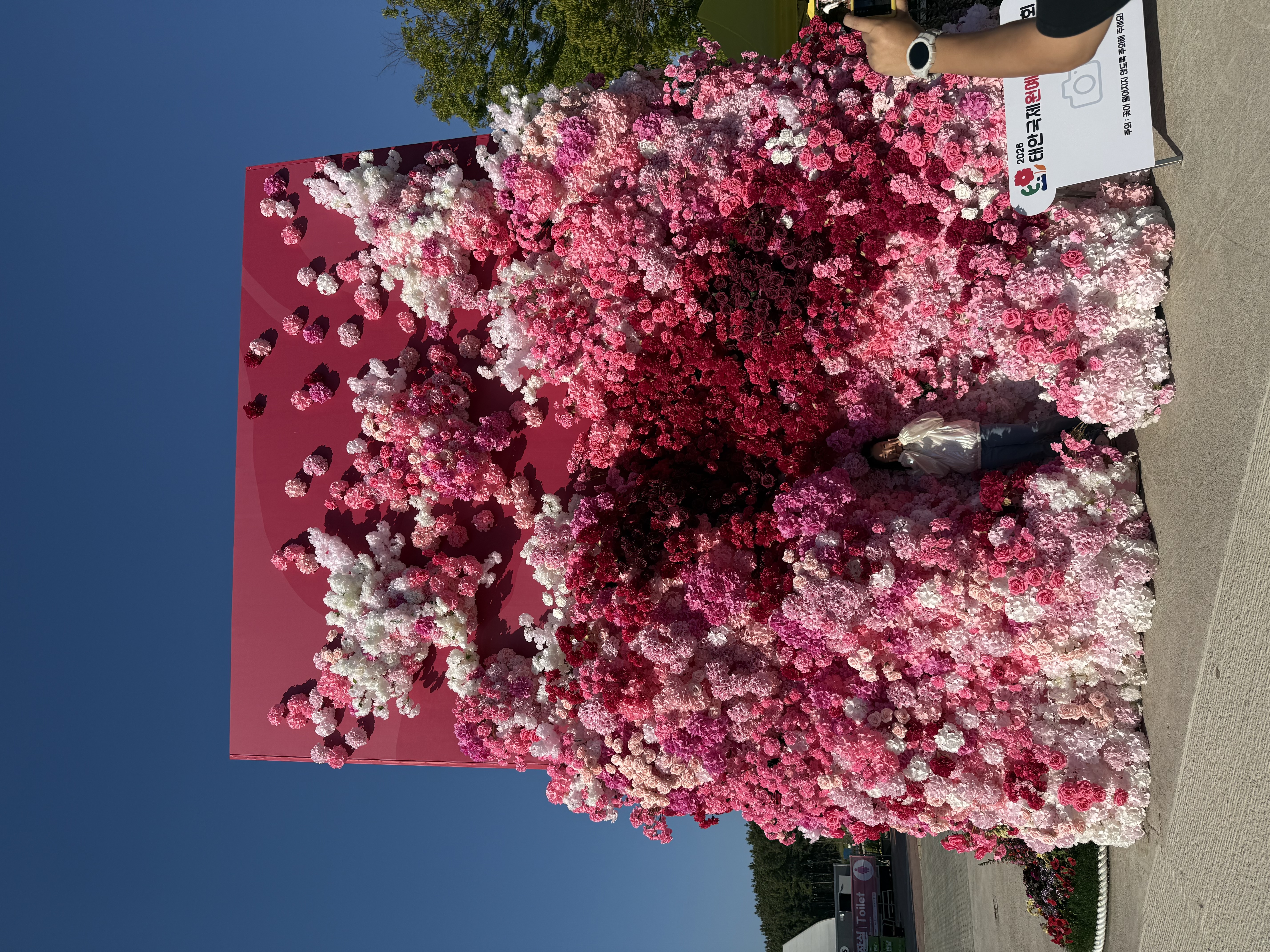
The outdoor flower fields were what we visited last and wished we’d visited first. The fields ring the indoor pavilions in concentric rings. Peony beds in one zone, carnations in another, lavender just starting to bloom in a third. The paths between zones are wide enough for strollers and wheelchairs. Most of the fields are at eye level for grade-school kids, which means kids can see the flowers face-on instead of looking down at them.
What worked for us specifically was the symmetry. Korean horticultural design tends to favor geometric patterns over wild gardens. Beds laid out in circles, squares, and concentric rings rather than the cottage-garden feel of European or American flower fairs. Our 9-year-old liked walking between the symmetrical beds and pointing at where the patterns broke. Our 10-year-old, less interested in flowers per se, became fascinated with counting how many beds shared the same color scheme.
Mid-afternoon light was the right time for outdoor walks. Earlier in the day the sun is high and shadows are short, which makes flowers look flat in photos. By 4 to 5 p.m. the angle is low enough that flowers cast shadows and the colors saturate. We took the best photos of the day in the outdoor sections, after we’d already spent an hour indoors.
Don’t skip the outdoor walks. They’re the most relaxed part of the visit and the part that most resembles what people imagine when they hear “horticultural expo.” The indoor pavilions are flashier and more memorable, but the outdoor walks give parents the breather they’ll need after two hours of character-zone overstimulation.
Three Things That Made Us Wish We’d Planned Differently
The 48,000 KRW Family Ticket
The entry fee structure is 15,000 KRW per adult and 9,000 KRW per kid. For our family of four (two adults, two grade-school kids) that came to 48,000 KRW. For comparison, a typical Korean theme park kids’ day pass might cost similar money but includes rides and shows that take a full day to consume. The expo doesn’t have rides. The price is for access to exhibits, not for thrill experiences.
For families on a tighter budget, this is the main downside. The expo is expensive enough that you want to make a full day of it to feel like you’re getting value. If you’re driving past on a tight schedule, the cost-per-hour ratio gets unfavorable fast. That said, all included activities (Sacred Garden, AI butterfly, Tini-Ping zones, ginseng planting) are part of the entry fee. No paid upgrades. No premium fast-pass pricing. The money you spend at the gate is the only money you spend, apart from food.
Four Hours Was Not Enough
We arrived at 4 p.m. and had to leave by 6 p.m. when the expo closed. Two hours was not enough. We saw the Sacred Garden, two Tini-Ping zones, the AI butterfly installation, the ginseng planting station, and one walk-through outdoor flower display. That left at least four other indoor pavilions, two character zones, two job-experience stations, and the larger outdoor flower fields completely unvisited.
For families planning a visit, plan to arrive by noon at the latest. The full circuit takes 4 to 5 hours. The lines for special pavilions like Sacred Garden can stretch out during the 2-to-4 p.m. peak. The outdoor fields are best in mid-afternoon when the light is warm but not hot, so plan your indoor pavilions for the morning and outdoor walks for after lunch.
The expo’s 9 a.m. to 6 p.m. window suggests a full day. Take that suggestion seriously. We left feeling like we’d skipped the better half of the show. Our 9-year-old kept asking about pavilions we walked past. She’d seen them on the map and knew what we’d missed.
The Food Situation
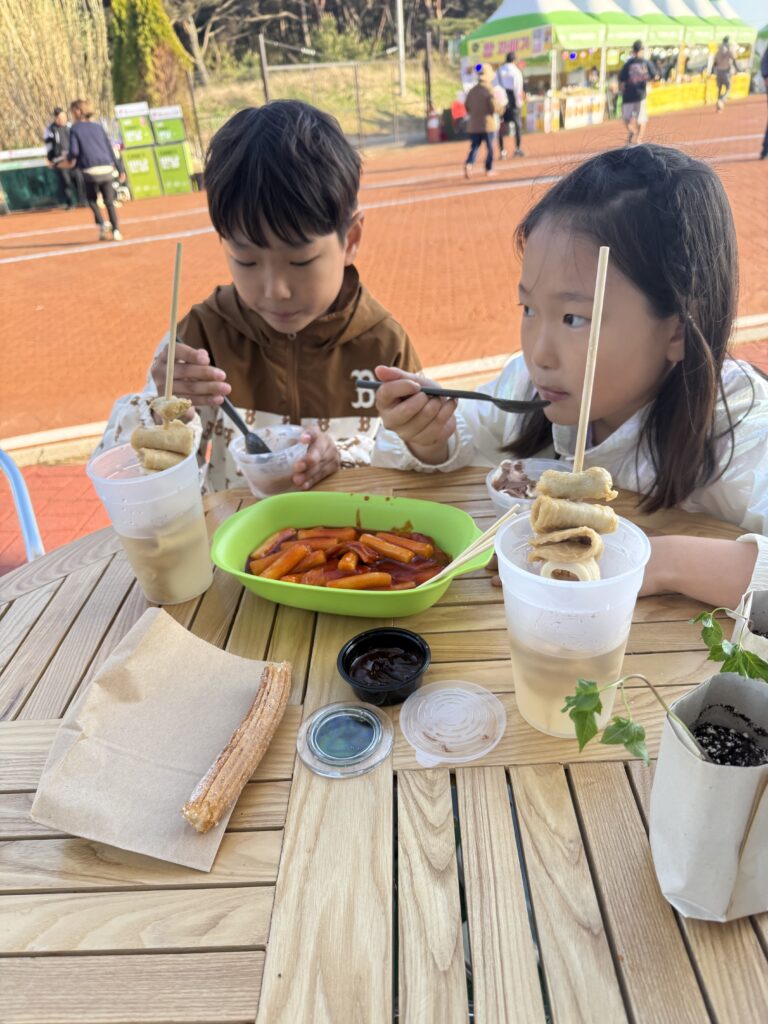
The food situation at the expo is fine but limited. We ate at one of the outdoor food tents that lined the path between exhibits. Standard Korean festival food: tteokbokki (떡볶이, spicy rice cakes), eomuk (어묵, fish cake skewers), and kkwabaegi (꽈배기, twisted donuts). Kids loved it. Portions were small. Prices were inflated noticeably over normal Korean street-food prices: 6,000 KRW for a small tteokbokki cup, 4,000 KRW for two eomuk skewers, 3,000 KRW for one kkwabaegi.
For a meal-sized stop, the food tents aren’t enough. There are no proper sit-down restaurants on the expo grounds. Families who want a real lunch should plan to leave the expo, drive to an Anmyeondo or Taean restaurant, eat, and come back, possible but inefficient with the entry fee already paid. Or pack a picnic and eat outside the gate. Or accept that you’re going to live on tteokbokki and kkwabaegi for the day.
For us, the snack-style food was fine. We had eaten a late lunch at Pungnyeon Hwesenta on Anmyeondo two days earlier and weren’t hungry for a full meal. For families arriving on empty stomachs, the food limitation is a real consideration. Bring snacks if you’ll be there for 4+ hours.
Quick Notes for Foreign Families
If you’re a foreign family planning a Children’s Day weekend in Korea, the Taean Horticultural Therapy Expo works as a half-day or full-day option even without strong Korean reading skills. Most installations are visual or interactive, not text-heavy. Sacred Garden requires no Korean. The AI butterfly responds to motion. Tini-Ping zones are entirely about photos. Ginseng planting is a follow-the-staff demonstration.
Translation apps like Papago or Google Translate handle the practical signs (entrance, restrooms, food) easily. The staff at the gate spoke basic English when we visited. The food tents have menu pictures, so ordering tteokbokki or kkwabaegi is point-and-pay. Card payments worked at the gate. The food tents preferred cash. Outdoor paths are flat but the indoor pavilions sometimes have ramps that get crowded. The Sacred Garden specifically has a queue zone before the entry. Bring a stroller-clip toy or snack to keep kids occupied during the wait.
Quick Reference for Visiting
📅 The 2026 expo runs through May 24. Daily 9 a.m. to 6 p.m. closing.
💰 Adult tickets are 15,000 KRW. Child tickets (ages 3–12) are 9,000 KRW. Under 3 enters free. Tickets at the gate, no advance booking needed for general entry.
⏰ Plan for a full day if you can. 4–5 hours minimum. Two hours covers maybe half the venue, and we left wishing we’d arrived at noon instead of 4 p.m.
🍴 Food is the weak point. Korean festival snack tents on-site (tteokbokki, eomuk, kkwabaegi at inflated prices), no sit-down restaurants. Bring snacks if you’ll be there over four hours.
🌸 If you only have time for a few zones, prioritize the Sacred Garden special pavilion, the AI butterfly installation, the Tini-Ping photo zones, and the free ginseng pot planting station. Skipping outdoor flower fields is fine if pressed.
📍 Location: Taean-gun, Chungcheongnam-do (near Anmyeondo). About 2.5 hours from Seoul via the Seohaean Expressway. View on Google Maps. Parking is on-site, free or low-cost depending on lot. Most paths are stroller-accessible, with ramps to indoor pavilions where there are steps.
By 6 p.m. the expo was closing, and the staff started ushering visitors toward the exits. Both kids carried their ginseng pots like trophies. Our daughter had a phone full of Tini-Ping selfies. Our son had a sticker pack from the seed-packet giveaway. We walked back to the parking lot in the late-afternoon sun. The kids were loud about which pavilion they wanted to see first if we ever got a real day there. We had to drive home.
Both pots sit on our kitchen window. The sprouts are taller than they were a few weeks ago, and our son waters them sometimes. Whether the 48,000 KRW felt worth it is genuinely a coin flip in my head. The two hours we got didn’t earn the price. The two pots and the Sacred Garden afterglow do, mostly because the kids keep talking about them.