Day 3 of our family camping at Naepo Camping Square turned out to be the activity-heavy day. Horseback riding for Korea kids was the headline event, and we’d booked it through the campsite the night before. But the day spread out further than that. Carrots for the rabbits next to the stable, horse-shaped key-chain sewing in the activity tent, a small flea market with a luck-draw machine, and a final-night dinner that wound down slower than the previous nights. Our 10-year-old son and 9-year-old daughter, who had spent the first two days at the cake-making and balloon-twisting stations, were ready for something more physical. Day 3 delivered exactly that.
Day 3 at Naepo Camping Square Was the Activity-Heavy Day
The first two days of our Children’s Day weekend had been more about the campsite itself. Settling in, cooking, doing the cake-making and balloon-dog activities at the main tent, watching the rainbow flame at the bonfire. Days 1 and 2 were the family bonding part. Day 3 was when the campsite added its bigger options.
The schedule was loose. Horseback riding ran in the morning at the equestrian club a 3-minute walk from the campsite gate. Key-chain sewing kicked off in the activity tent around lunchtime. The flea market opened in the afternoon next to the entrance. Recreation games filled the gaps. Each activity ran independently, and families could mix and match through the day.
Since we had pre-booked horseback riding the night before, we got the partnership rate. The campsite has a partnership with the equestrian club next door, so the rate was 19,000 KRW per kid (although the standard public rate is 20,000). For families with two kids that’s a small saving, but every family-of-four trip in Korea has those small partnership discounts, and over the course of a long weekend they add up.
What follows is structured around what each kid responded to differently. Same activities, two very different reactions, which is how a long camping day actually plays out with two grade-school kids.
What the 9-Year-Old Loved Most: Horseback Riding on a Lunge Line
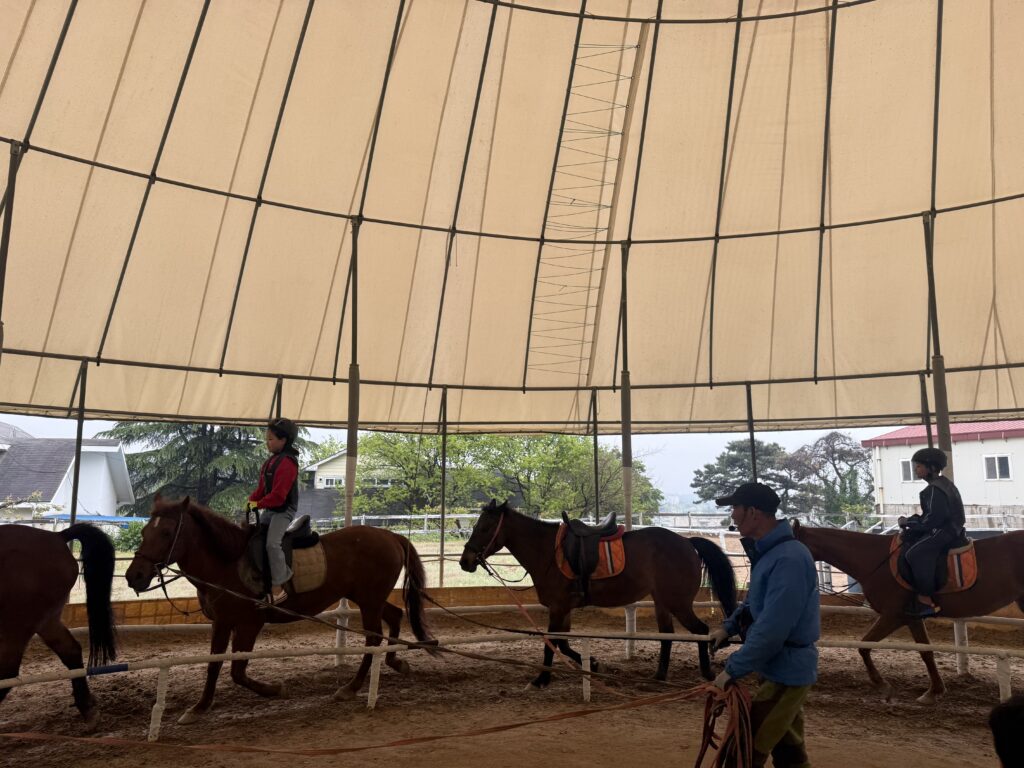
The horseback riding setup at the equestrian club next to Naepo Camping Square is not the simple lap-around-the-paddock kind that most Korean theme parks offer. We had braced for the usual: a child sits on a horse, a handler walks the horse for one slow circle, the kid says it was fun, the parent pays a small fee, everyone leaves. Although that kind of horseback riding for Korea kids is everywhere, it’s also forgettable.
Why the Lunge Line Setup Was Different
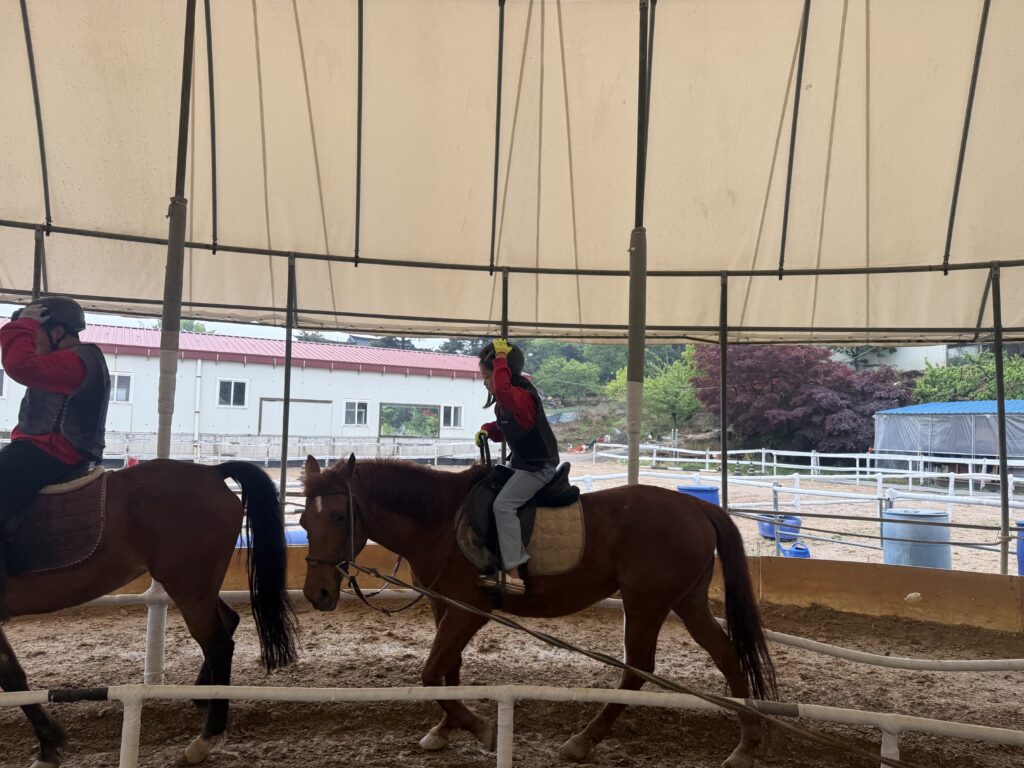
This was different. The coach used a lunge line, a long lead rope attached to the horse’s bridle. He stood in the center of a covered ring while four kids on four different horses circled him at a real trot. Real trot. The horses bounced. So did the kids. They had to grip the saddle, keep their backs straight, hold the reins lightly, and not panic when their horse decided to speed up because the horse next to them sped up.
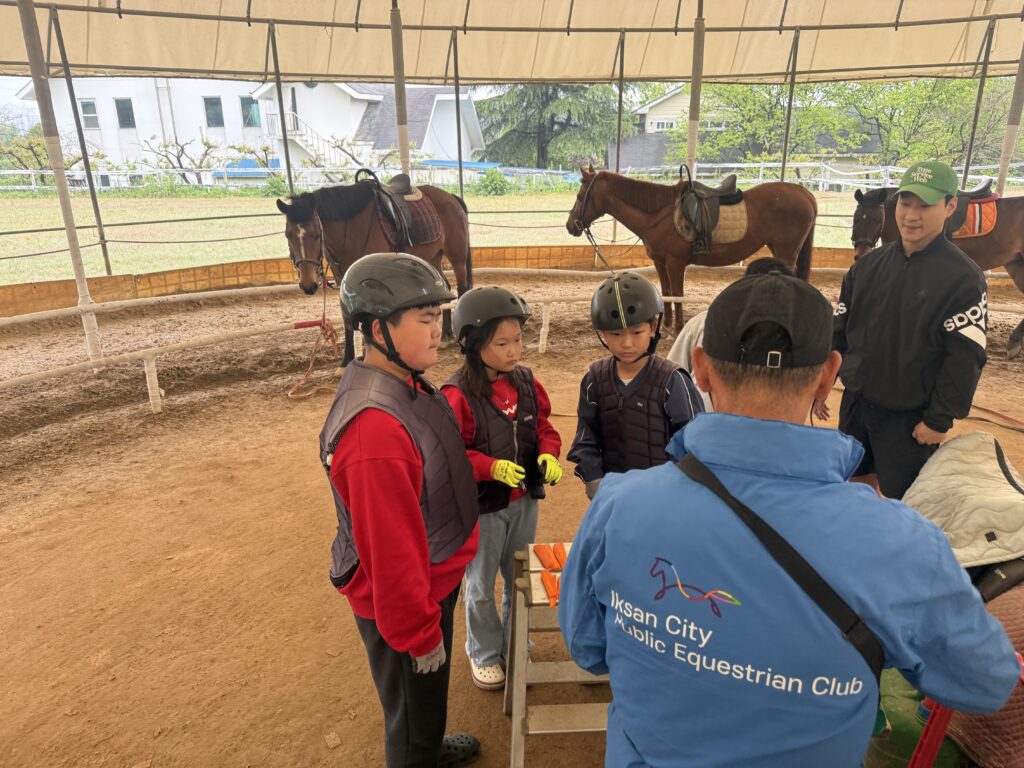
The coach was patient and clear. He gave each kid a name-stick to identify them from across the ring (so he could correct posture without yelling generic “you, the one in the red helmet!”). He’d shout, “elbows in!” or “heels down!” or “look forward!”, and the kid would adjust. A short cycle later the same correction. Then the kid would self-correct without the shout. That’s the cycle of any good coaching session. He had it dialed.
The Coach Pulled Aside and Said the Younger One Has a Feel for It
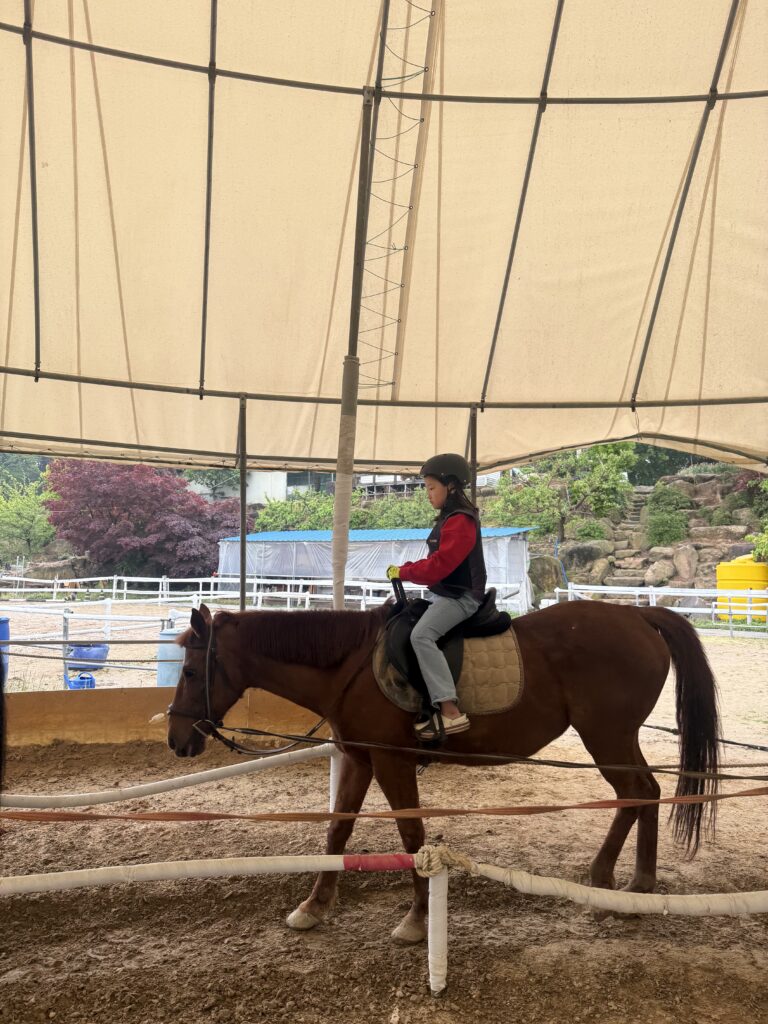
About a quarter into the session, the coach pulled aside and said, in Korean, “the younger one has a feel for the horse.” He gestured at our 9-year-old daughter. He said it the way coaches say it when they actually mean it. Quietly, without performance, almost like he didn’t want to embarrass her in front of the others.
While her hands stayed quiet on the reins, her weight didn’t shift around aggressively. She was reading the horse’s pace and matching it. Her brother was riding with more enthusiasm, but with more bounce and more correction needed. The horse responded to her differently because she gave it less to fight against.
Later in the car, my wife asked her if she wanted to take more lessons sometime. She said yes, but only if she could ride the same horse. (She had already named it. The coach hadn’t told her the actual name.) We didn’t promise anything. Riding lessons in Korea aren’t cheap, and our weekend schedule is already a tight tetris. But it sat in our heads as something we’d loop back to.
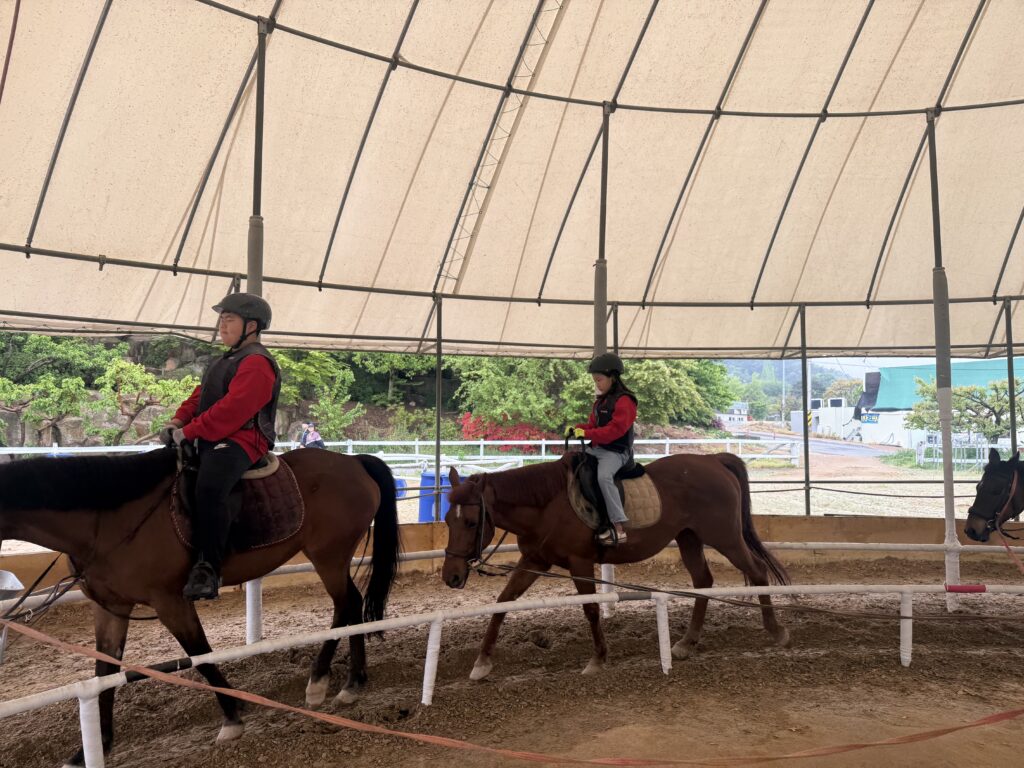
Equipment, Horses, and the 30-Minute Group Pace
The session ran roughly half an hour per group. Helmet, vest, gloves provided. Boots were not. Although kids wore their own sneakers, which is fine for a beginner trot lesson, they were obviously not real riding boots. While the horses were Korean-bred quarter horses, mid-sized and calm by horse standards, none of them spooked or broke into a canter. The whole thing felt safe enough that I stopped worrying about my kids in the saddle within the first few minutes.
What the 10-Year-Old Loved Most: Feeding Rabbits and Ducks
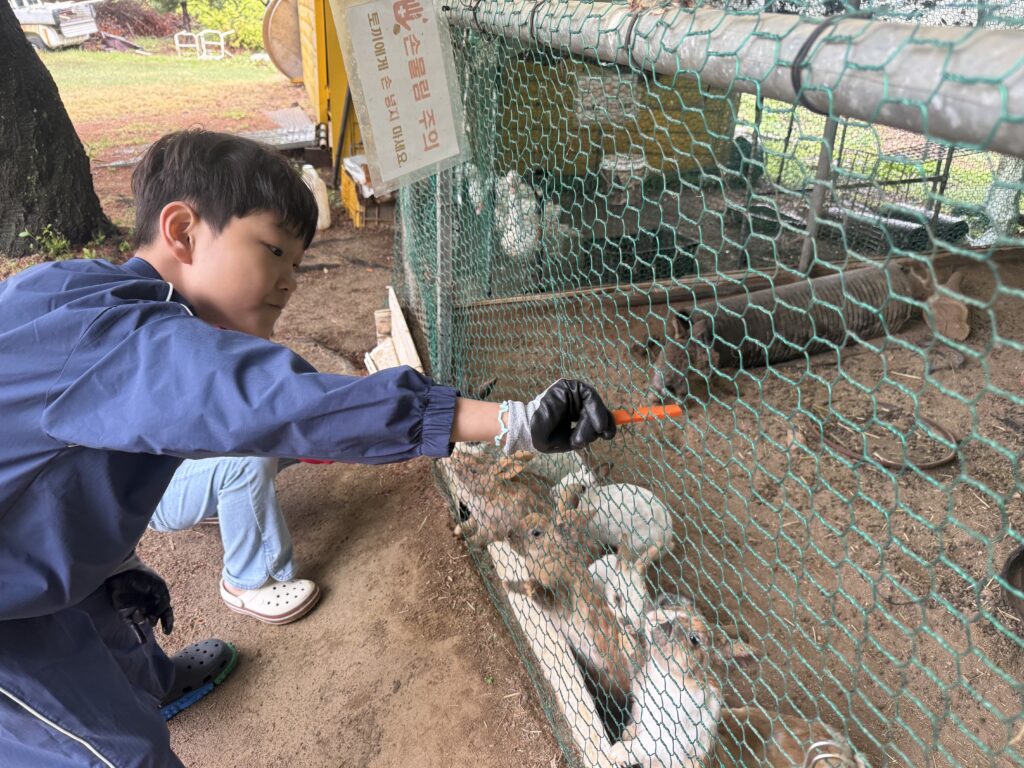
When the riding session ended around 11 a.m., the kids dismounted into a bonus the campsite hadn’t advertised: a small petting area next to the stable with rabbits and ducks in mesh enclosures. The equestrian club gave each rider a handful of carrot sticks for free. “Feed them on your way out,” the coach said.
Our son went straight to the rabbit cage. A handful of rabbits in there of varying sizes, mostly white and gray, all crowding the wire when they smelled carrots. He fed them through the mesh, one rabbit at a time, with the gloves the coach had lent him still on. The rabbits took the pieces gently. No bites. No snatching. His sister joined a minute later, and the two of them spent a long stretch feeding rabbits with focused, quiet attention. Of the four activities on Day 3, this was the one that calmed him the most.
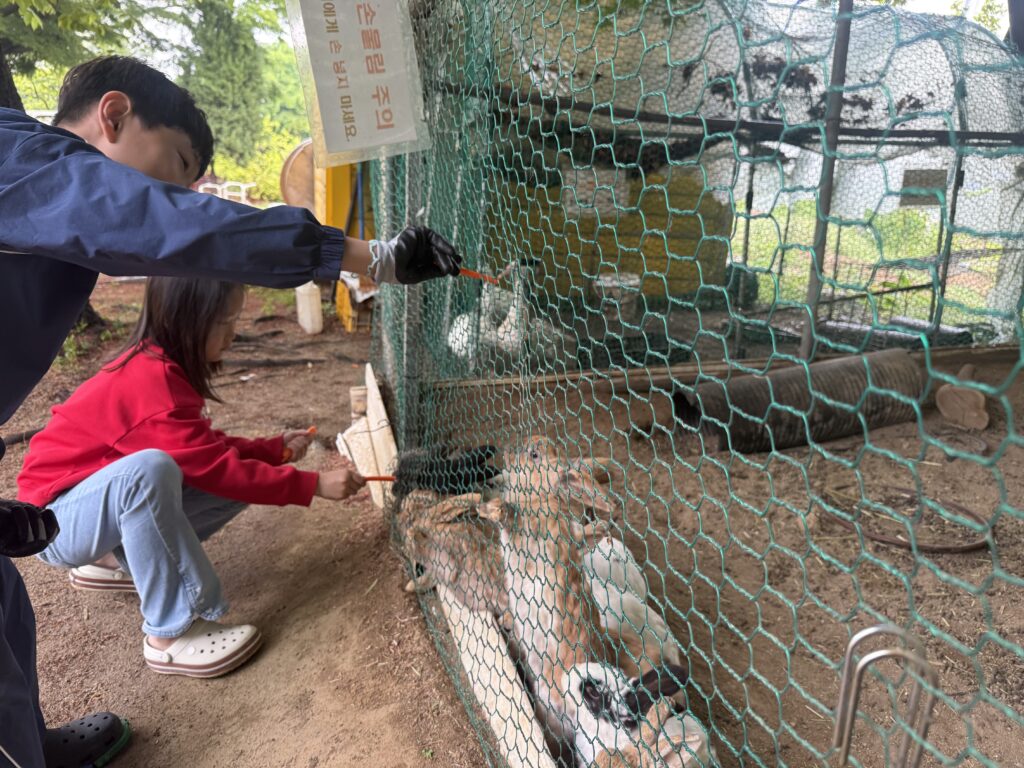
Why the Petting Area Worked as a Reset
The ducks were harder. Ducks don’t take carrots gently. They peck. Both kids learned this within seconds, and they started dropping the carrots through the mesh from a safe distance instead. Ducks would race over, eat them in two bites, and look up for more. Our son laughed harder at the ducks than at the rabbits. Ducks have personality.
Since the petting area is small and unfussy, there’s no formal entrance and no additional fee. Just a stable-side animal corner that the equestrian club uses partly for kids and partly because they keep the animals anyway. For a 10-year-old who’d just been corrected on his riding posture for half an hour, this was the activity that felt like reward.
What Both Kids Did Together: Sewing the Felt Horse Key Chains
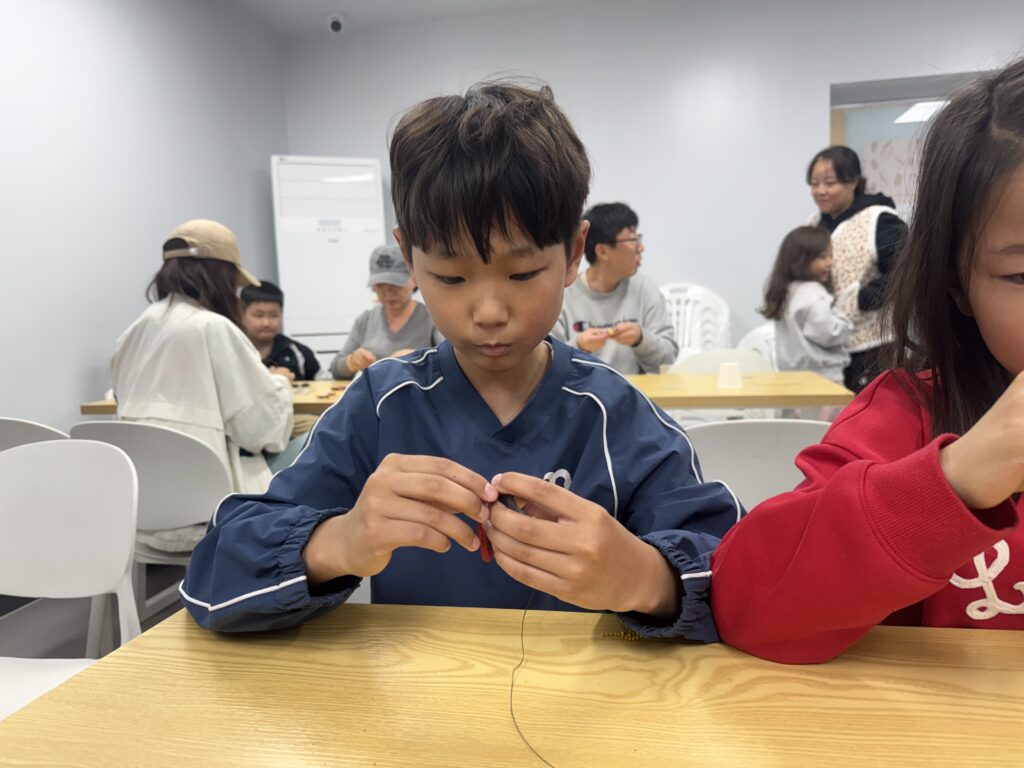
When we came back to the campsite at noon, we found the activity tent had switched stations. The cake-making materials from Day 1 had been replaced with key-chain DIY kits. Wooden rocking-horse shapes, colored felt squares, embroidery thread, small needles, ball-chain rings, beads. Each kid got to pick the colors of their key chain. Felt body, felt mane, felt saddle, the works.
This activity required real sewing. Real, with real needles. The kids had to thread the embroidery thread through the holes punched into the felt pieces, attach the felt to the wooden horse, and tie off the thread without losing the bead patterns. Our daughter, despite her steady hands at horseback riding, had no idea how to use a needle. Same with her brother. Neither had done sewing before. Korean elementary curriculum still includes some hand-craft, but our kids’ school had been on a craft hiatus.
So my wife and I sat down next to them and helped. A lot. Thread kept knotting. Needles kept slipping out of their fingers. Felt would shift, and the holes wouldn’t align. Our son wanted to give up about a third of the way through. His sister, who had decided her horse was going to be yellow with a green mane, refused to quit until it was done.
What the Finished Key Chains Looked Like
Although both key chains came out wonderfully imperfect, that was the point. Threads visible. Felt slightly off-center. Beads that didn’t match. Each kid had a key chain that looked exactly like a 9- or 10-year-old had made it. They both attached them to their backpacks the next day. While our daughter’s yellow horse with green mane survived the rest of the trip and is still on her school bag at the time of writing, our son’s lasted about a week before the felt mane peeled off, and then he stopped caring about it.
An Activity They Argued Over: The Flea Market Claw Machine
By 3 p.m. the flea market opened along the camp’s main path. Local vendors and parents from the campsite had set up small tables with handmade items. Woven bracelets, hand-painted stones, kid art, used board games, and a few oddities like one table with vintage fishing lures (which I genuinely considered buying). Most items were cheap, in the 1,000 to 5,000 KRW range. The vibe was casual community-market more than commercial booth.
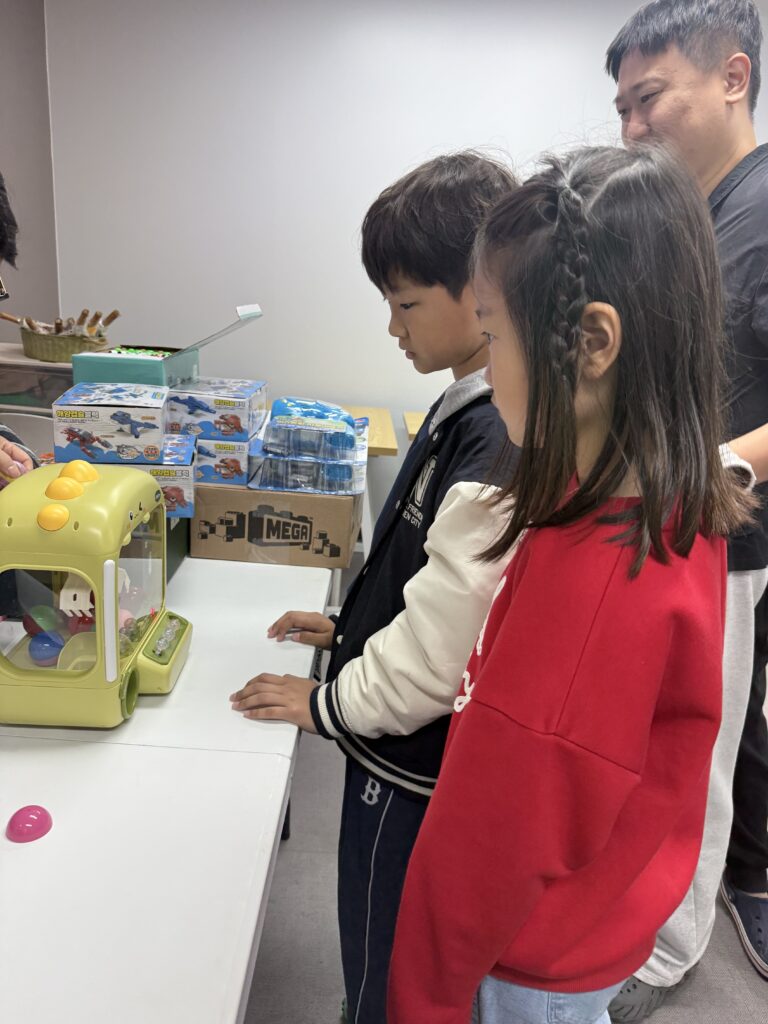
Both kids walked through it with us briefly, and then they locked onto one specific table. A luck-draw claw machine the campsite had set up next to the flea market entrance. It was the size of a small arcade unit. You inserted a 1,000 KRW coin, the claw would drop into a pit of paper tickets, and you’d grab one and unfold it. Each ticket either had a winning number for a small prize at the redemption table, or said “꽝” (no prize). Either way the kids loved it.
A Sticker Pack, a Pencil, and a Trade
So we let them try a few times each. About half won small prizes. A sticker pack, a pencil, a candy bar. The other half said “꽝.” Both kids were thrilled. Our son got the sticker pack and the candy bar, while his sister got the pencil. They argued about whose prizes were better, then traded.
Although we didn’t actually buy anything from the flea market itself, the visit still worked. The flea market is more of a vibe activity, a way to give kids a sense of community and adult shopping while keeping costs low. The claw machine was the actual hook. Korean campsites often run little claw-machine and arcade-style games for kids. The prizes are tiny, the cost is tiny, and the surprise factor is what kids actually enjoy.
Notes for Booking and Walking In
Equestrian Club and Riding Details
- 📍 Equestrian club: 3-minute walk from Naepo Camping Square gate
- 🐴 Horseback riding rate: 19,000 KRW per kid via the campsite partnership (standard 20,000 KRW)
- ⏰ Riding session: ~30 minutes group lesson on the lunge line, helmet + vest + gloves provided. Wear closed-toe sneakers
- 🥕 Animal petting: Free with riding session. Carrots provided by the equestrian club
- 🐎 Booking: Reserve through the campsite the day before. The club can fill quickly on long-weekend mornings
Crafts and Flea Market on Day 3
- 🎨 Key-chain DIY: Free as part of the Children’s Day program. Materials and needles provided. Adult help recommended for kids new to sewing
- 🛍️ Flea market: Opens around 3 p.m. on Day 3. Vendor items 1,000–5,000 KRW
- 🎰 Claw-machine luck draw: 1,000 KRW per ticket. Mix of small prizes and “꽝” no-prize tickets
Age Range and Stroller Access
- 🧒 Recommended age range: 5–12 years across all Day 3 activities. The horseback riding lesson works best for 7+
- 👶 Stroller access: Most activities are stroller-friendly. The stable area has dirt paths but they’re flat
A few small things we’d do differently if we go again. Book the horseback riding earlier, ideally at check-in. Bring closed-toe sneakers with thicker soles for the gravel walk back from the petting area. Carry small cash bills, since flea market vendors had no card readers and the claw machine only takes 1,000 KRW coins or bills. And try a longer riding session next year. The half-hour group lesson on the lunge line was a great intro, but the 9-year-old was clearly ready for more by the end. A 60-minute one-on-one private lesson with the same coach would be a logical next step.
Day 3 ended with a quieter campsite dinner. The kids were physically exhausted, the key-chain sewing had drained whatever attention span they had left, and the flea market had used up their last burst of social energy. We ate at the deck with the screen room up. Quiet. Our 10-year-old fell asleep at the dining table at one point and we carried him to the tent. The 9-year-old held her yellow-and-green key chain through dinner like it was a passport.
The next morning we packed up. Loaded the car. Drove out at 10 a.m., made the lunch stop at Pungnyeon Hwesenta on Anmyeondo for grilled clams, and continued home. The yellow-and-green key chain is still on her school bag at the time of writing. It looks worse than it did three weeks ago. She likes it more.