Our first proper stop on the Jeju trip was a place I had seen all over Korean social feeds. The Little Prince Tangerine Farm is one of those spots that blew up online. It’s half petting zoo, half themed tangerine orchard. I wanted to see if it lived up to the hype with our own two kids in tow.
It sits a bit out from where we were based, but the drive was easy, about half an hour of quiet Jeju roads. We rolled in mid-morning after breakfast, not knowing quite what to expect. What we got was one of the better family mornings of the whole week, and a couple of things I’d tell you before you go.
- 📍 Location. Southern Jeju, about a 30-minute drive from Jeju City
- 🏷️ Category. Family Travel (themed farm and animal feeding)
- 💰 Price. A cafe drink plus a separate admission ticket per person
- 🎯 Best age. Roughly 3 to 12, though ours at 9 and 10 loved it
- ⭐ Overall. 4.3 / 5
Getting There and the First Look
The drive out was part of the fun. Jeju’s inland roads are quiet and lined with green, and about half an hour slipped by without a single “are we there yet.” We had the windows down and the kids watching for tangerine fields along the way.
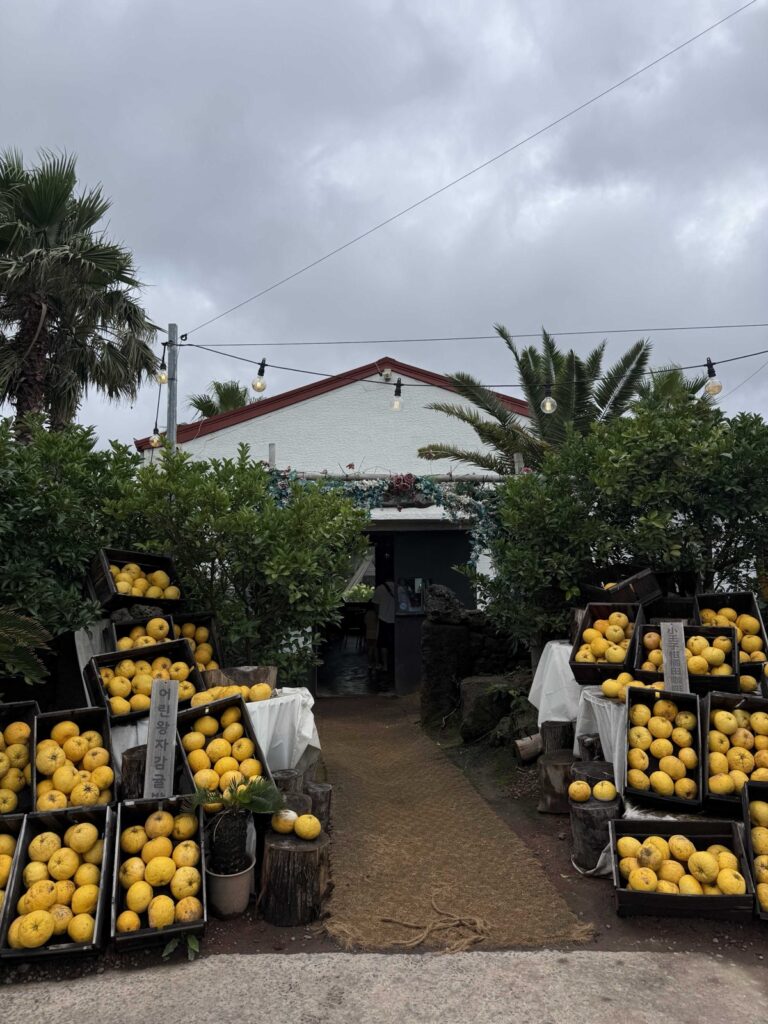
You know you’ve arrived before you park. Crates of tangerines are stacked along the entrance path, bright against the gravel, and the whole approach has a hand-made, homespun look to it. It doesn’t feel corporate. It feels like a family orchard that turned into an attraction, which is more or less what it is.
Parking was simple on the morning we went. We pulled in, grabbed the sunscreen, and walked up the path with two kids already running ahead.
You Enter Through a Cafe, and Buy a Ticket
The setup here is a little unusual, so it helps to know it going in. You don’t just walk into the farm. You enter through the cafe first, and the way out to the orchard runs through the back of it. A sign near the door makes it clear that you buy a drink before you head out.
On top of the cafe order, there’s a separate admission ticket for the farm itself. That caught me slightly off guard, since I’d assumed the drink was the price of entry. It is not. You pay for both. Entry alone is ₩15,800 per person, and entry plus a drink is ₩16,800. A thousand won more for a drink, so that math took about two seconds. The two adults took combos and the kids went in on entry-only tickets. Once we sorted that out, the rest was smooth, and every ticket came with animal feed and marshmallows included.
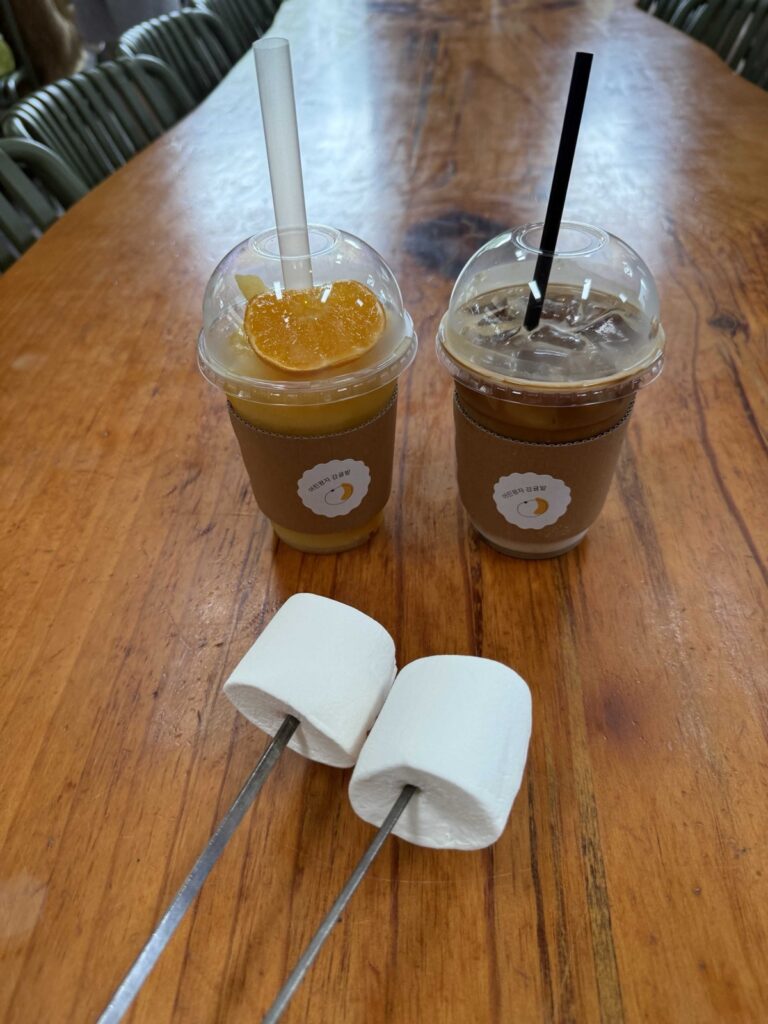
The combos got us a hallabong ade and an iced americano. We picked up the marshmallow skewers and headed for the door at the back. The kids were already bouncing before we stepped outside. They could hear the animals through the glass.
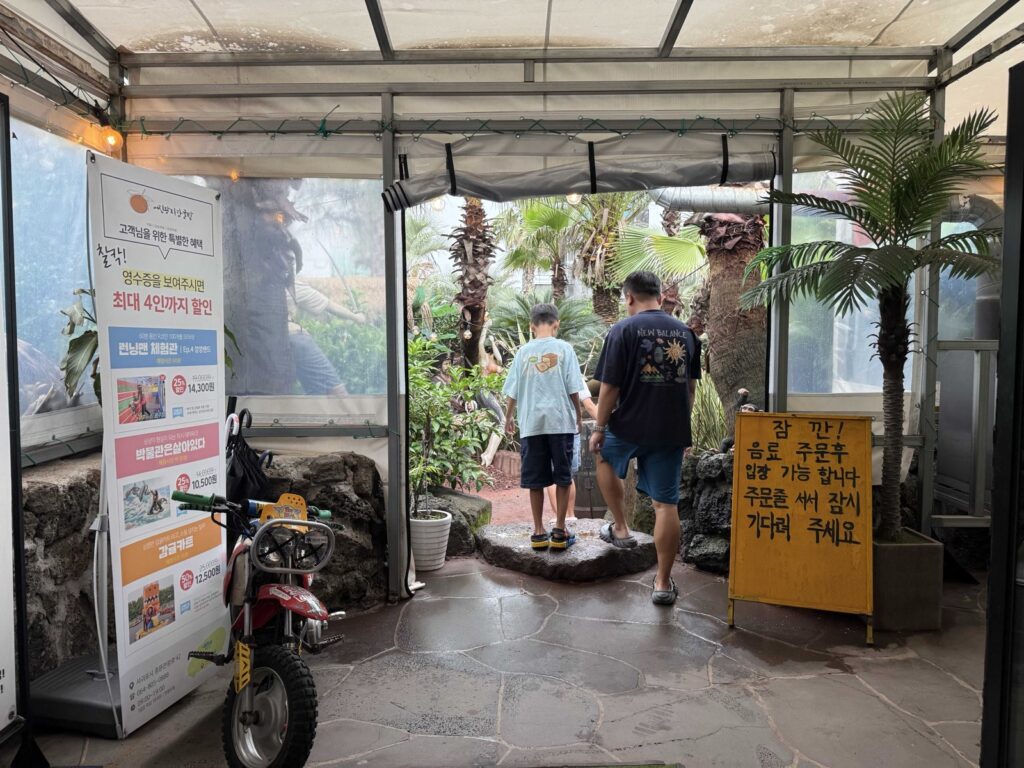
The cafe itself is worth a look on the way through. It’s done up like a jungle greenhouse, with dried plants hanging from the ceiling and odd little props tucked into every corner. There’s a life-size alpaca statue in a hat, a suit of armor standing among the potted palms, and enough greenery that the kids kept spotting things we’d walked straight past.
It’s a good spot to regroup, honestly. If you’ve got a younger kid who needs a break from the animals, or the weather turns, the cafe gives you somewhere cool and shaded to sit. We started here and ended here, and both stops felt right.
The Themed Orchard Is Half the Fun
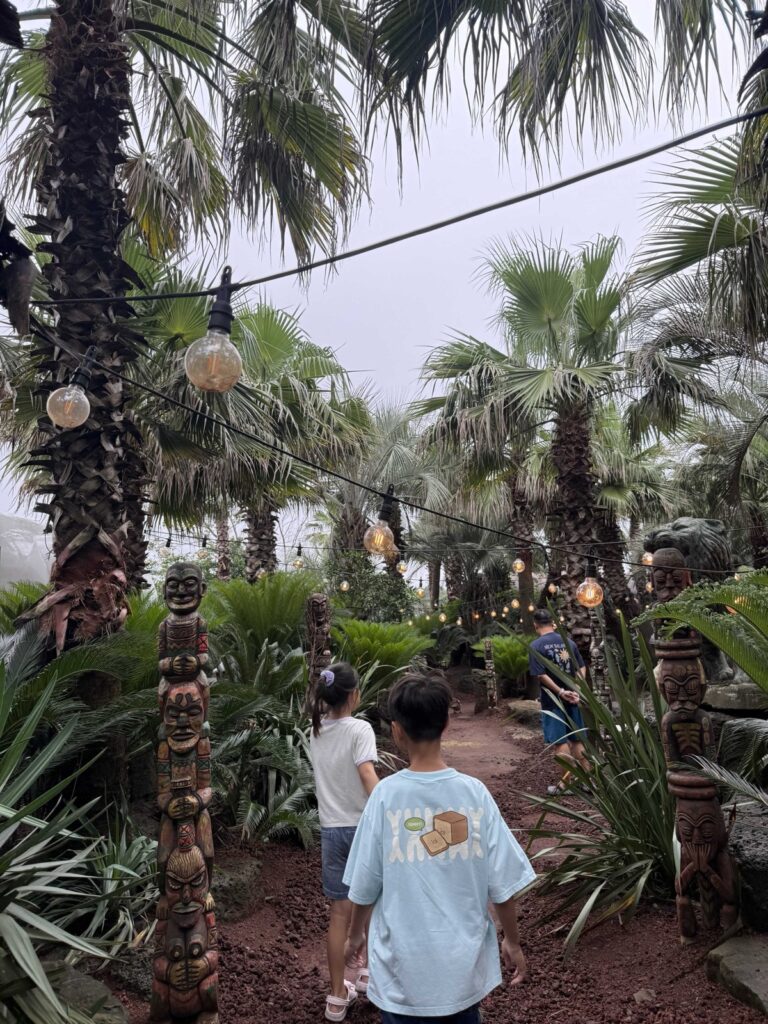
Step through that door and the place opens up into a themed garden that’s honestly a bit wild. Palm trees are strung with globe lights. Dol hareubang, the Jeju grandfather stone statues, stand guard along the paths. Totem poles and animal figures are scattered in among real tangerine trees. It leans hard into whimsy, and the kids ate it up.
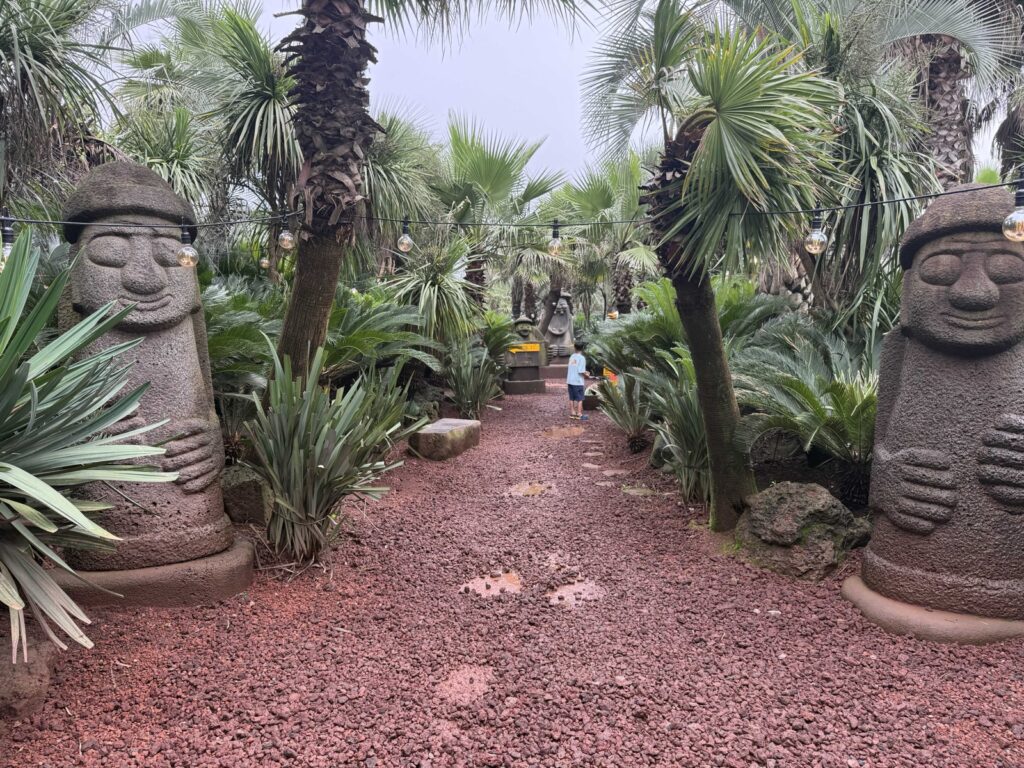
The dol hareubang are a genuine Jeju icon, carved from the island’s volcanic rock, so it was a nice bit of local flavor rather than random theming. If you want the background, there’s a decent rundown of dol hareubang worth a quick read. Our older one had seen them before and was pleased to explain them to his younger sister, whether she asked or not.
The Little Prince name fits the mood better than I expected. There’s a storybook, slightly dreamy quality to the whole garden, with its odd statues and fairy lights strung between the palms. It doesn’t hammer the theme at you. It just gives the place a gentle sense of make-believe that pairs well with a morning of feeding goats. The kids didn’t know the book. They liked the fairy lights and the weird statues anyway.
A signed walking route loops you through the garden in a rough order, past statue clusters and feeding stations. It’s not big, but it’s dense with things to look at. We slowed right down and let the kids wander, which is the whole point of a place like this.
Unlimited Feed and Animals Everywhere You Look
The real draw is the animals, and there are a lot of them. Ducks and geese waddle around loose on the paths. Goats stand on rocks like they own the place. There are ponies, cows, guinea pigs, and, further along, a couple of ostriches. Some are penned, some roam, and the kids never quite knew what they’d meet around the next corner.
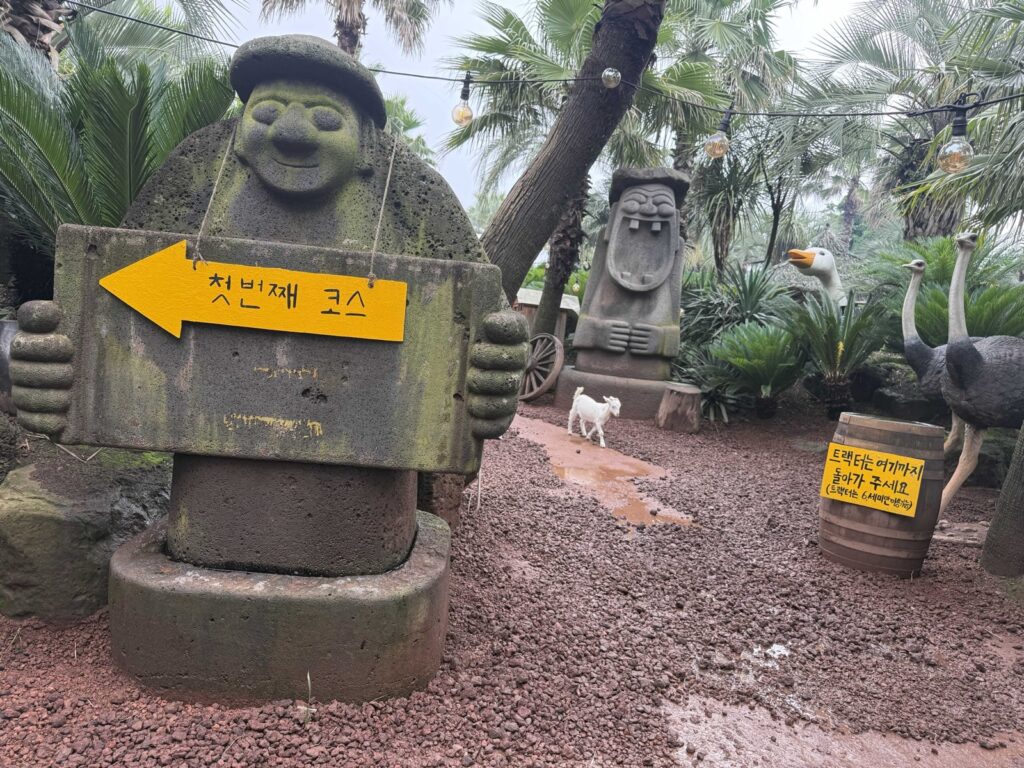
The loose goats were the biggest hit with our two. Some stood up on rocks to reach a bowl, and a few trotted right up looking for more, which sent the kids into fits of laughter. One cheeky one followed our daughter down the path for a while, clearly convinced she was holding out on it. She wasn’t, but it made her morning to be chased by a goat that wanted her attention.
The Feeding Never Really Stops
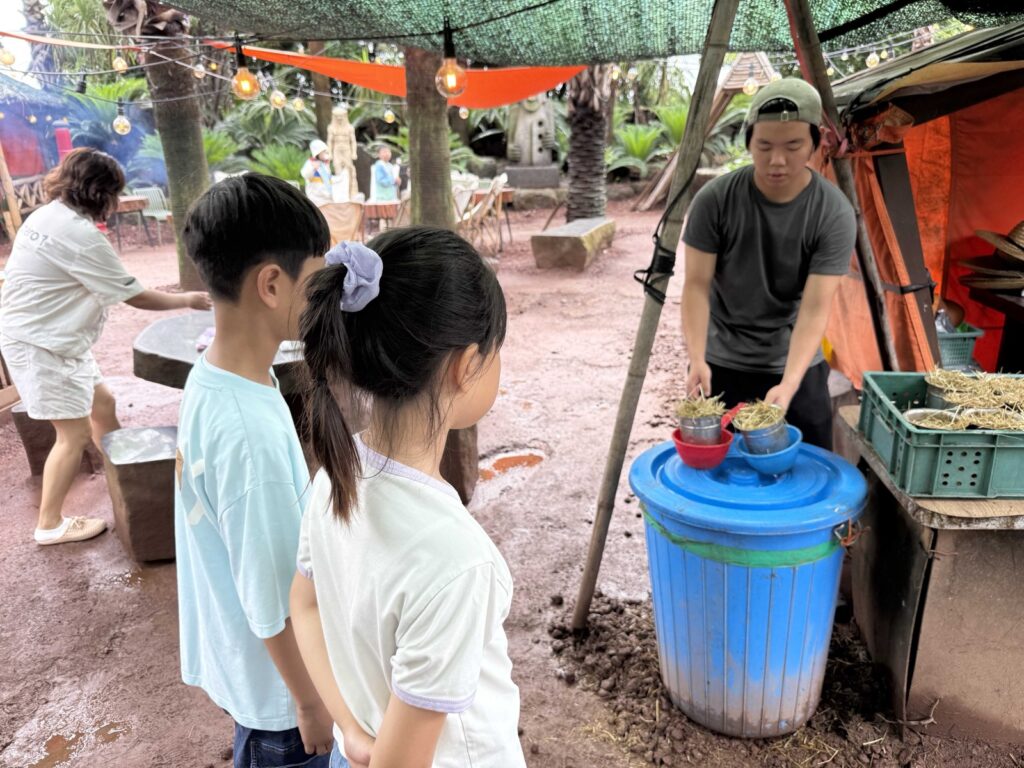
The feed is the clever part. A staff member scoops animal feed into little bowls for you, and you can keep coming back for more. Unlimited refills. For a kid, handing food to a goat over and over is apparently the best thing in the world. Both of ours went through bowl after bowl without getting bored.
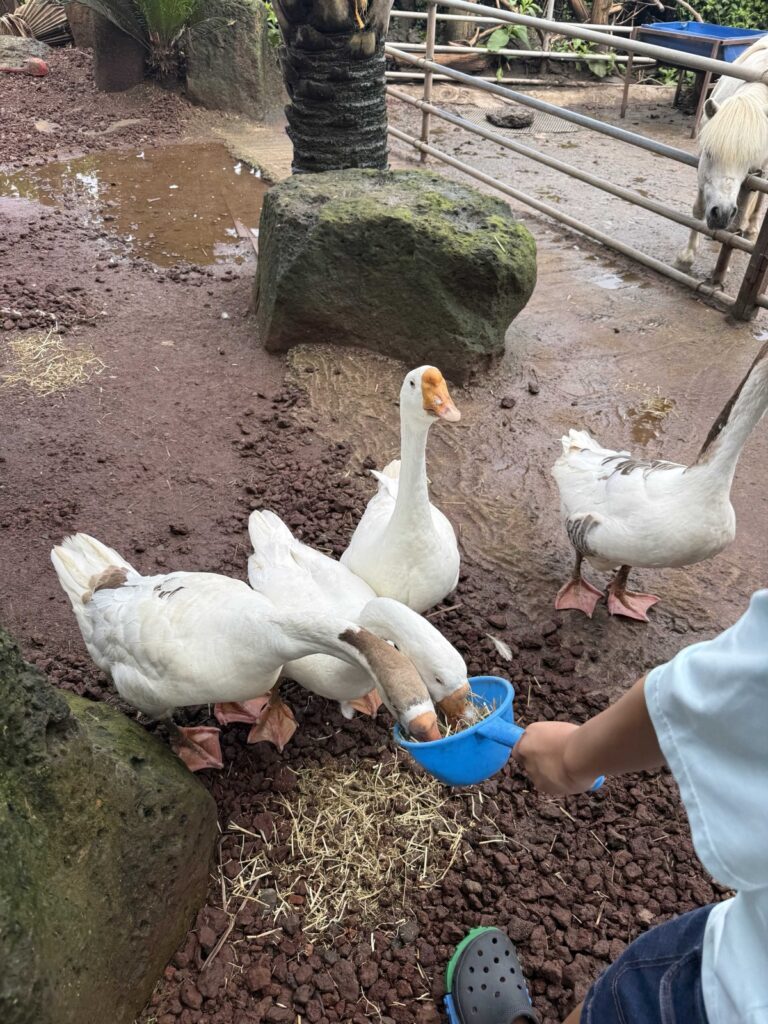
The geese were the first big hit. Our younger one crouched down and let them eat straight from the bowl, half thrilled and half nervous every time a beak got close. Then came the cows, who lean their heads over a low rock wall and take feed with a slow, gentle patience that even a jumpy kid can handle.
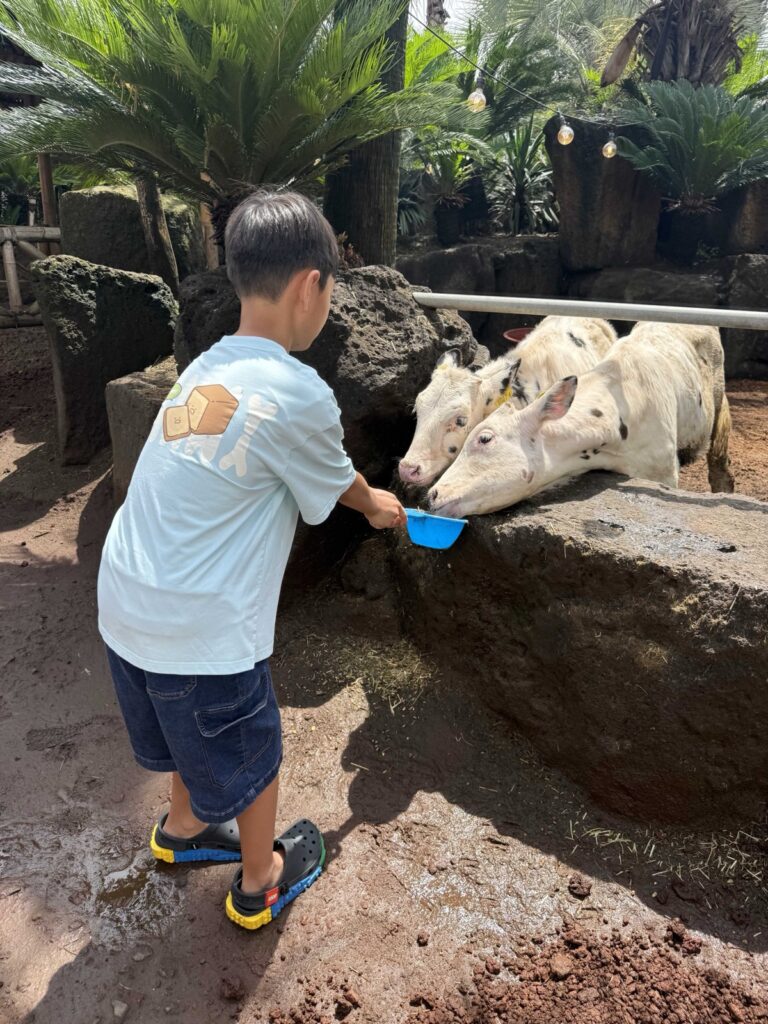
The ponies and guinea pigs were quieter draws, but the kids found them too. A pony paddock sits off to one side, with a few ponies standing patiently behind a rail. Further along there’s a hutch of guinea pigs, which our daughter could’ve watched for an hour. Not every animal here is about feeding. Some are just there to be visited, and that variety kept the loop from feeling repetitive.
The Ostrich Was the Showstopper
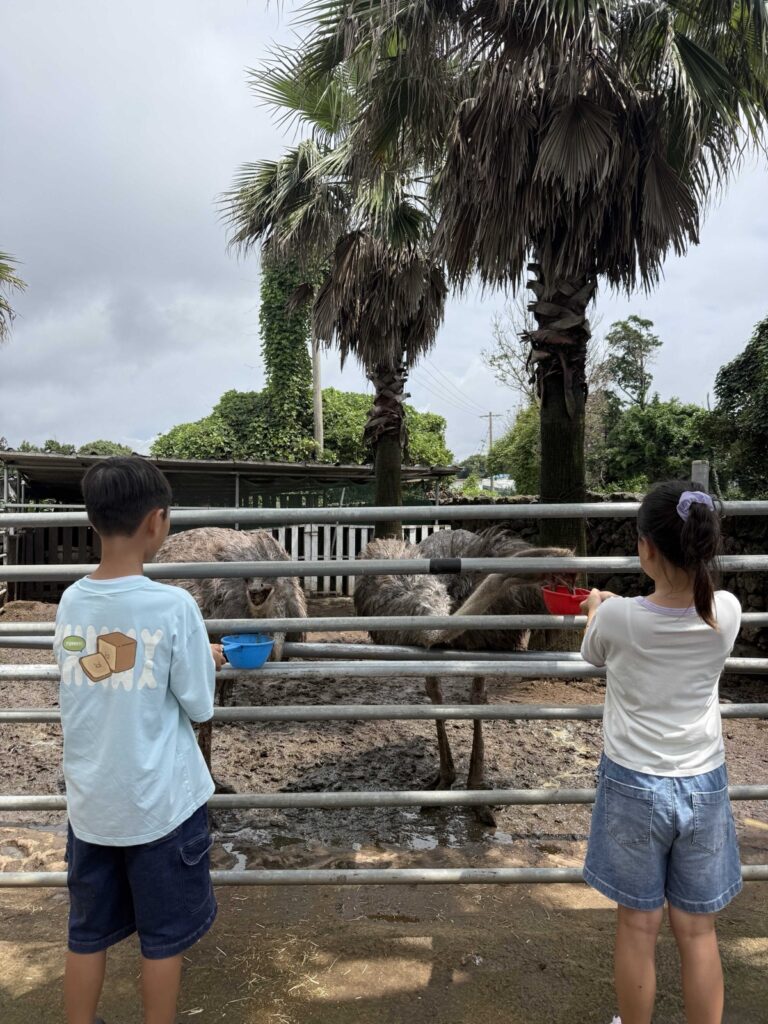
Nothing got a bigger reaction than the ostriches. They’re large, a bit prehistoric-looking, and they take feed through the rails with a fast bob of the head that makes kids shriek and laugh at once. Both of ours went quiet for a second when the first ostrich leaned down, then dissolved into giggles.
Our son, who talks a big game about not being scared of anything, took a solid step back when the beak came for the bowl. He recovered fast and kept going, but I caught the flinch, and I’ll be reminding him of it for years.
Roasting Marshmallows Over the Fire
Tucked into the garden is a fire pit area where you roast the marshmallows that came with your ticket. After all the feeding, this was the perfect way to slow the morning down. The kids skewered their marshmallows and hovered over the flames with the intense focus only a nine-year-old chasing the perfect toast can manage.
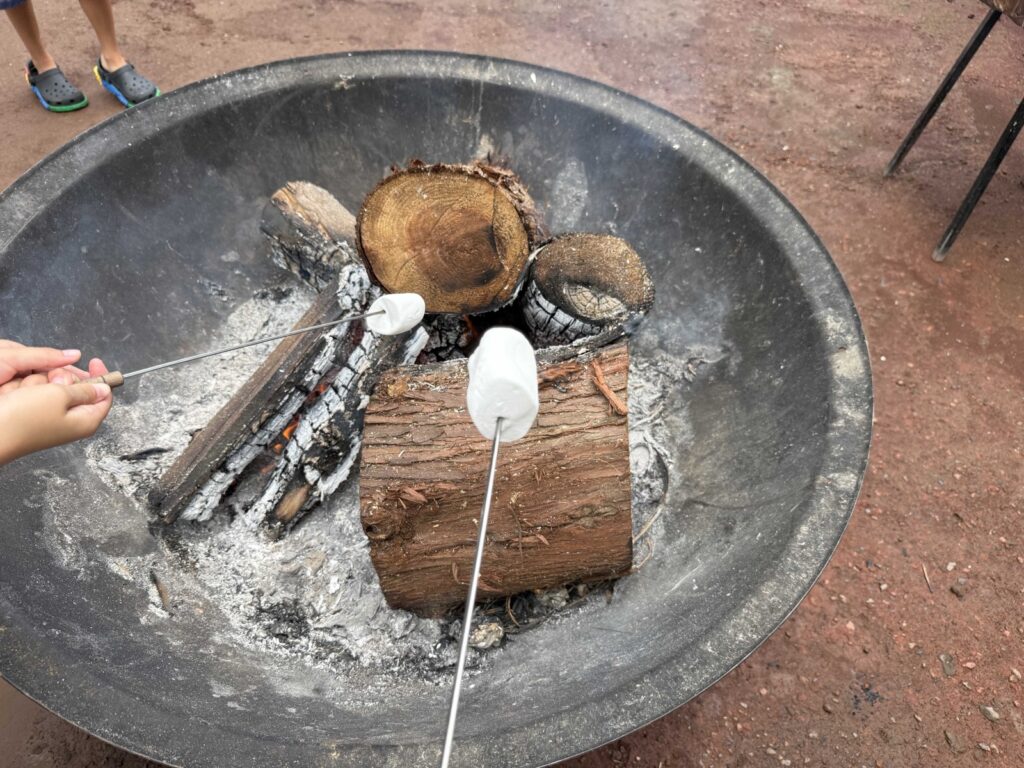
It’s a small touch, but it turned the visit from a quick animal loop into a proper morning out. We sat by the fire, the kids compared their charred marshmallows, and for a few minutes nobody was asking to go anywhere else. I got to finish my americano before the ice melted, which basically never happens.
A word of warning for parents. Roasting sticks and an open fire mean you want eyes on the little ones here. It’s well set up and felt safe, but a fire pit is still a fire pit. We hovered close while the kids toasted, and that felt like the right call.
It Is Made for Photos, and the Kids Did Not Mind
There’s no getting around it. This place is built to be photographed. The globe lights, the stone statues, the palms, and the tangerine crates all make easy, pretty backdrops, and that’s a big part of why it took off online. On a clear day it would be even better, though ours was overcast and still looked good.
I’m usually wary of spots that exist mainly for the camera, since they can feel hollow once you put the phone down. This one earns it, because the animals and the feeding give you a real thing to do. We took plenty of photos, mostly of the kids from behind as they fed a goat or leaned toward a cow. But we weren’t just there to shoot. We were there to play, and the setting happened to be lovely.
How Long You Will Spend Here
We spent about two hours, and that felt right for our two. That covered the full loop, a lot of repeat feeding, the marshmallow fire, and a slow drink in the cafe at either end. You could do it faster if you rushed, but rushing kind of misses the point.
If your kids are deep into the animals, you could stretch it toward a half day without much effort. I’d budget two to three hours to be comfortable, and pair it with lunch somewhere nearby afterward. It slots neatly into a morning, which is exactly how we used it before moving on to the next stop.
How Crowded Was It?
This was the pleasant surprise. For a place that’s all over social media, it wasn’t crowded at all when we went. There were other families around, but never a crush, and we never had to wait for a feeding station or fight for space at the fire.
My guess is it’s still riding the early wave of attention, so the crowds haven’t fully caught up to the hype yet. That may not last. If you can, go on a weekday or early in the day, while it still feels calm. The quiet was a big part of why we enjoyed it as much as we did.
Being uncrowded changes the whole feel of a petting place. The animals were calm rather than swarmed. The kids could take their time at each station without a line building behind them. If this spot gets as popular as the photos suggest it will, I suspect a busy weekend would be a very different, more hectic visit. We got the good version, and I’m glad we did.
A Word on Different Ages
Our two are 9 and 10, and this age hit a sweet spot. They were old enough to feed the animals confidently, hold their own bowls, and follow the loop without much hand-holding. They were also still young enough to be genuinely delighted by a goat on a rock.
For younger kids, say toddlers and preschoolers, it still works, but you’ll be more hands-on. The bigger animals like the ostriches and cows can be a lot for a small child, so you’ll want to steer them toward the gentler geese and goats. For older tweens and teens, the animals may wear thin faster, though the themed garden and the marshmallow fire give them something beyond the feeding.
If I had to name the ideal range, I’d say about 4 to 11. Ours are near the top of it, and neither one asked to leave early.
Is It Worth the Money?
This is where I want to be honest, because the pricing is the one thing that gave me pause. You pay per person, and for a family of four it adds up faster than you expect. Ours came to ₩65,200 all in, two entry-plus-drink combos for the adults and two entry-only tickets for the kids. That’s not a cheap morning for what is, on paper, a petting zoo.
So is it worth it? For us, yes, but with a caveat. The unlimited feed and the marshmallows do a lot to justify the ticket, and the kids got a solid two hours of genuine joy out of it. If your kids are animal-mad, the value lands. If they’re lukewarm on petting zoos, I’d think twice, because the ticket assumes you’re there for exactly that.
One thing that softened the sting was that nothing else nickel-and-dimed us once we were inside. The feed kept coming, the marshmallows were part of the deal, and there was no upsell at every turn. Plenty of family attractions get you in cheap and then charge for each little extra. This one front-loads the cost and then leaves you alone, which I actually prefer. You know the number up front, and then you just enjoy the morning.
Where the Farm Scored With Us
Here’s how it broke down across the things we usually track. The value score is the one that pulls the average down, and you already know why.
- ⭐ Family Friendliness 4.5 / 5. Built for kids, with staff who keep the feed and marshmallows flowing.
- ⭐ Age Fit (9 to 10 yrs) 4.5 / 5. Old enough to feed confidently, young enough to be delighted.
- ⭐ Variety of Activities 4.5 / 5. Animals, themed garden, and a fire pit in one loop.
- ⭐ Safety & Access 4 / 5. Easy paths and gentle animals, though watch small hands at the ostrich rail.
- ⭐ Value for Money 3.5 / 5. The cafe-plus-ticket stack is the weak point.
- ⭐ Overall 4.3 / 5.
If You Are Planning a Visit
A few practical notes to save you the small surprises we ran into. This is the stuff I wish I’d known before we drove out.
- 🚗 Getting there. About a 30-minute drive from Jeju City. A rental car is the easy way to reach it.
- ☕ How it works. Buy a cafe drink, then a separate admission ticket. Feed and marshmallows are included with the ticket.
- 🗺️ Map. Google Maps
- 🎂 Age range. Great for roughly 3 to 12. Ours are 9 and 10 and were fully into it.
- 🕒 Best time. Weekday or early morning, before any crowd builds.
- 🧥 Bring. Closed shoes for the gravel paths, and hand wipes after the feeding.
If you’re still shaping the wider trip, the VisitKorea site is a fine place to start for Jeju basics and getting around.
Would We Go Back
We would, though probably not every trip. It’s a lovely one-off morning rather than a place you return to again and again. The theming, the animals, and the marshmallows made it a genuine highlight, and both kids named it when we talked about their favorite parts of Jeju later.
On the way out, our daughter asked if we could take one of the goats home. We could not. She asked again in the car, and by dinner the goat had a name.
More Jeju Trip and Animal Days Worth a Look
- Hotel Aircity Jeju, where we stayed the first night of this same trip
- Horseback riding at Naepo Camping Square for another animal day with kids
- Everland Night Safari if your kids love getting close to animals